
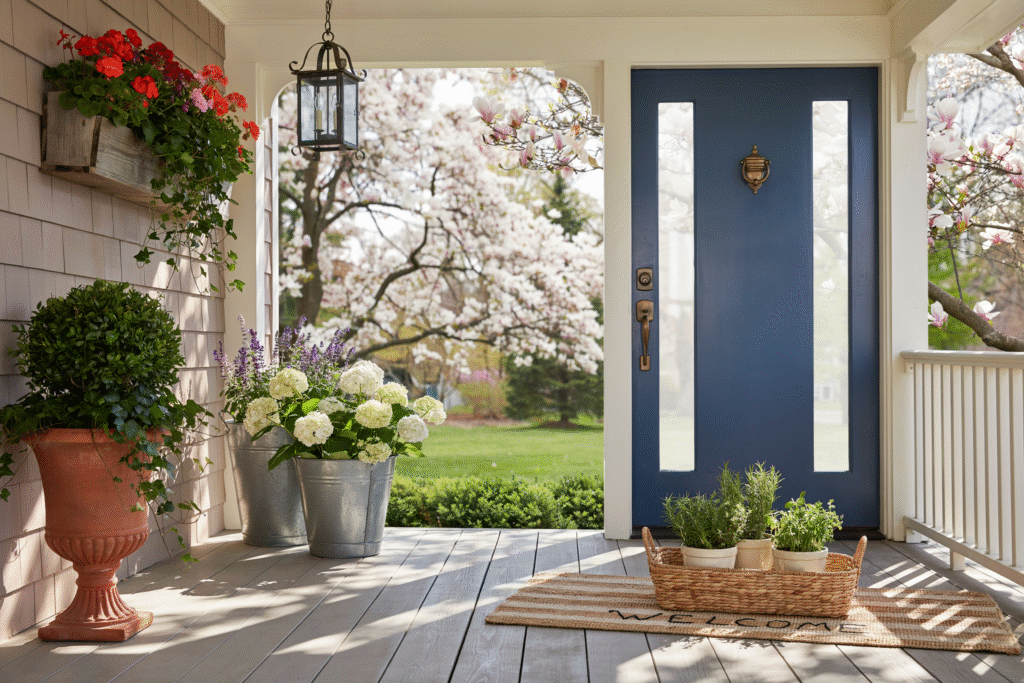
Space-smart placement strategies + seasonal planting plans + sun, shade, and style guidance — everything the generic small porch guides leave out.
A small porch is not a consolation prize. It is a precision exercise — and when you approach it correctly, the constraint produces something far more considered and visually striking than a large porch ever could. The most memorable front entrances are rarely the biggest ones. They are the ones where every single decision was intentional: the right planter in the right spot, planted with exactly the right thing for the season, the light, and the style of the home.
The problem with most front porch planter ideas guides for small spaces is that they focus entirely on where to put the pots and completely ignore what to plant in them — which is precisely the information that determines whether your porch looks beautiful for three weeks or beautiful for twelve months. This guide fixes that. It covers both: the space-smart placement strategies that make a small porch look larger and more curated, and the planting guidance for every sun condition, every season, every style, and every maintenance preference — including the best front porch planter ideas with fake plants for those who need a genuinely maintenance-free solution.
The result is a complete small porch planting system you can actually use, season after season, for an entrance that always looks like it was styled on purpose.
The Small Porch Planting Principles: What Changes When Space Is Limited
Contents
- 1 The Small Porch Planting Principles: What Changes When Space Is Limited
- 2 Part One: Space-Smart Placement Strategies
- 2.1 1. The Single Statement Planter: Maximum Impact, Minimum Footprint
- 2.2 2. Vertical Column Planters: Go Tall, Stay Narrow
- 2.3 3. Rail Planters: Reclaim Your Railing
- 2.4 4. Wall-Mounted Planters: Turn Vertical Surfaces Into Display Space
- 2.5 5. Step Planters: Use Every Level
- 2.6 6. Hanging Baskets: Claim the Ceiling
- 3 Part Two: What to Plant, Seasonal and Condition Guides for Small Porch Planters
- 3.1 Front Porch Planter Ideas for Full Sun
- 3.2 Front Porch Planter Ideas for Partial Sun
- 3.3 Front Porch Planter Ideas for Shade
- 3.4 Front Porch Planter Ideas for Spring
- 3.5 Front Porch Planter Ideas for Fall
- 3.6 Front Porch Planter Ideas for Winter
- 3.7 Front Porch Planter Ideas Year Round
- 3.8 Front Porch Planter Ideas: Evergreen Options
- 3.9 Front Porch Planter Ideas with Fake Plants
- 3.10 Front Porch Planter Ideas: Modern Style for Small Spaces
- 4 The Small Porch Planter Quick-Start Checklist
- 5 Frequently Asked Questions
- 5.1 What is the best single planter idea for a very small front porch?
- 5.2 Can I have colour year-round on a small porch without replanting constantly?
- 5.3 What are the best front porch planter ideas for a small porch in full shade?
- 5.4 Do fake plants look convincing on a front porch?
- 5.5 How do I stop small porch planters from looking cluttered?
- 6 Final Thoughts
Before diving into the ideas, three principles apply specifically to small porches that do not matter quite so much on large ones:
On a small porch, floor space is the scarcest resource. Any planter strategy that moves display space upward, onto rails, walls, steps, or brackets, frees the floor and prevents the entrance from feeling crowded and hard to navigate. Tall, slim planters always outperform wide, spreading arrangements in tight spaces.
🌿 Porch planters sorted — now style the outdoor space beyond the door. These 12 pergola styling ideas use curtains, climbing plants, string lights, and furniture to create a shady, magazine-worthy outdoor escape right in your own backyard:
➤ 12 Pergola Styling Ideas for a Shady, Stylish Outdoor EscapeVisual noise is the enemy of a small space. Too many competing pot materials, plant colours, and heights read as clutter rather than abundance. The most striking small porch planter arrangements use a single consistent pot colour or material, a unified planting palette, and a clear compositional logic.
The counterintuitive truth about small porches is that larger planters look better than smaller ones. A single large, confident planter creates a statement; three small mismatched pots create mess. When floor space is tight, one well-chosen large pot is almost always the right answer.
Part One: Space-Smart Placement Strategies
1. The Single Statement Planter: Maximum Impact, Minimum Footprint
When a porch is genuinely small,barely wider than the door itself, the single-statement planter is the most powerful front-porch planter idea available. One oversized, beautifully chosen container placed to one side of the door with absolute confidence creates a composed, editorial entrance that looks nothing like a compromise.
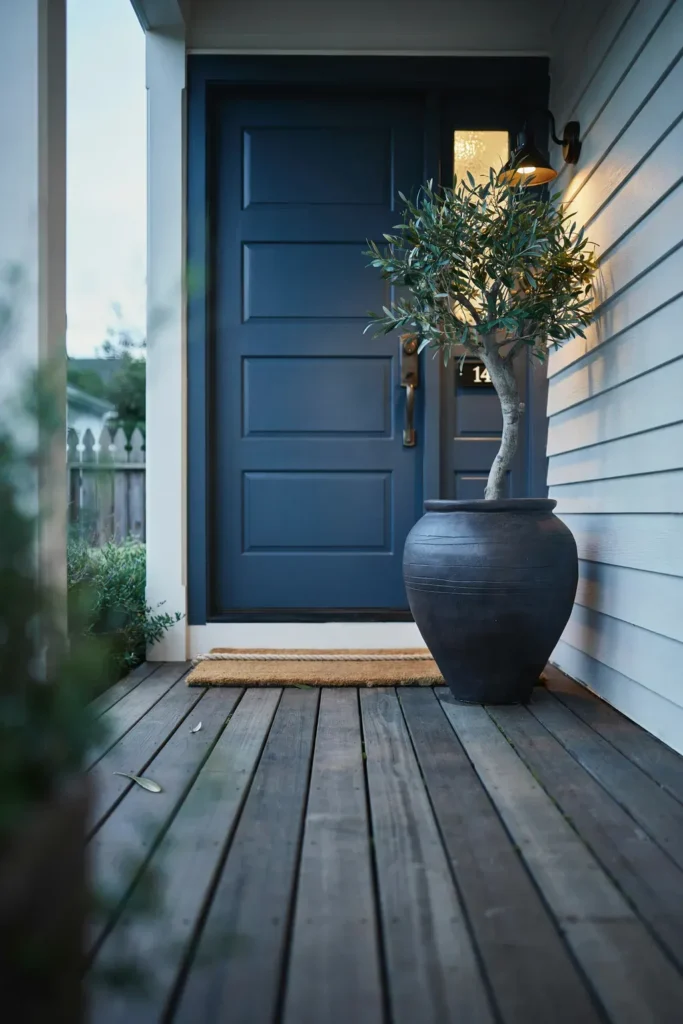
The key word is oversized. A large fluted ceramic pot in warm sand or architectural off-white, a substantial concrete cylinder, or a tall tapered fibreglass planter in matte black — each reads as a deliberate design choice rather than a default. Fill it with one dramatic plant: a standard clipped bay tree, a tall ornamental grass, a sculptural agave, or a well-grown olive tree. The negative space around it becomes part of the composition.
2. Vertical Column Planters: Go Tall, Stay Narrow
Column planters, tall, narrow, and architectural, are the most space-efficient of all front porch planter ideas and entrance solutions because they occupy almost no floor area while delivering significant visual height. A pair of slim column planters flanking the front door creates instant symmetry and frames the door without encroaching on the passageway.
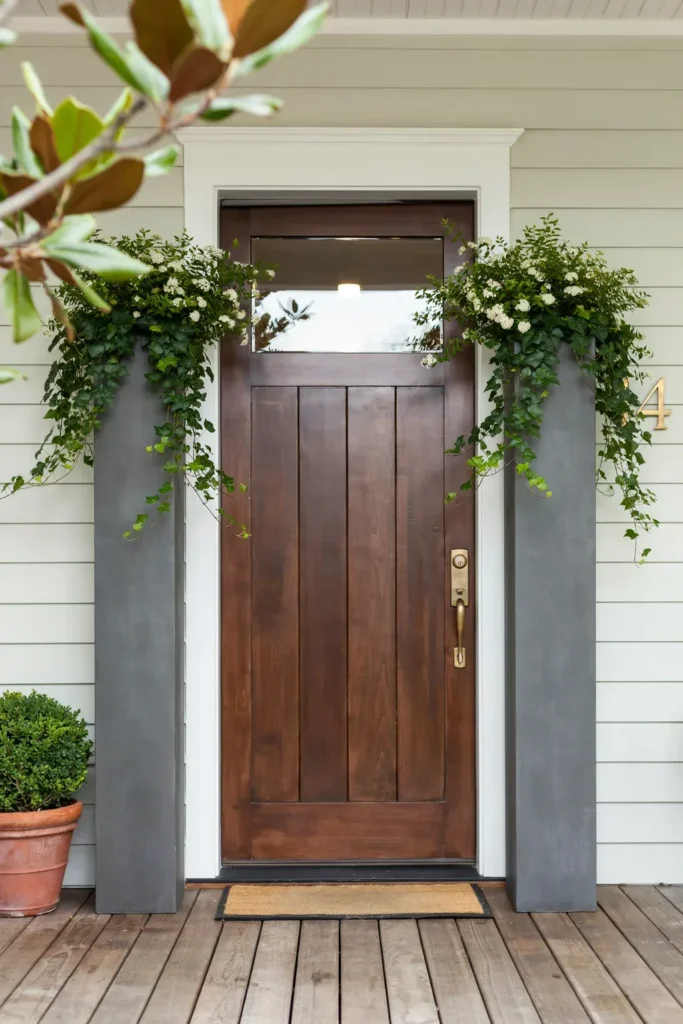
For maximum effect, choose a height that reaches at least two-thirds of your door frame — this proportion makes the planters feel like they belong at the scale of the architecture rather than sitting timidly below it. Materials that work beautifully in column form: smooth rendered concrete, tall fibreglass cylinders, cast iron with surface detail, and tall glazed ceramic in deep tones.
Single-species upright planting reads cleanest in a tall narrow form, a clipped box cone, a single agapanthus stem, or a standard rosemary. Add one trailing element to spill slightly over the rim and soften the geometric precision.
3. Rail Planters: Reclaim Your Railing
If your porch has a railing, you have display space that most people never use. Rail planters, long window-box style containers designed to clip or hook directly onto porch railings, add an entire horizontal planting zone to your entrance without consuming a single centimetre of floor space.
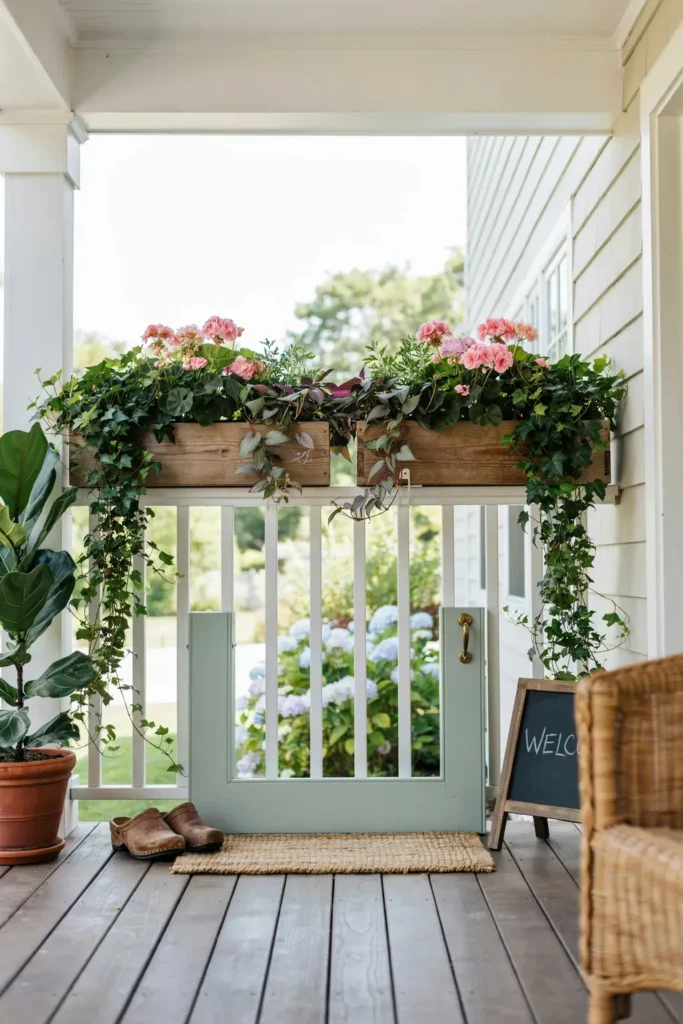
The cascading effect of plants trailing over a railing and down toward the path below creates a lush, layered abundance that makes a small porch feel like a much more generous space than it actually is. The railing itself disappears beneath the planting, all that remains is a horizontal ribbon of greenery and colour framing the entrance.
Trailing lobelia, bacopa, trailing verbena, nasturtiums, ivy, and calibrachoa. Mix one trailing variety with one compact upright to add height above the railing line.
4. Wall-Mounted Planters: Turn Vertical Surfaces Into Display Space
The wall beside your front door is prime real estate that most small porch owners completely ignore. Wall-mounted planters, brackets holding single pots, modular pocket systems, or shelf-style ledges with planting space, transform flat vertical surfaces into layered display areas that contribute enormously to the entrance aesthetic without touching the floor.
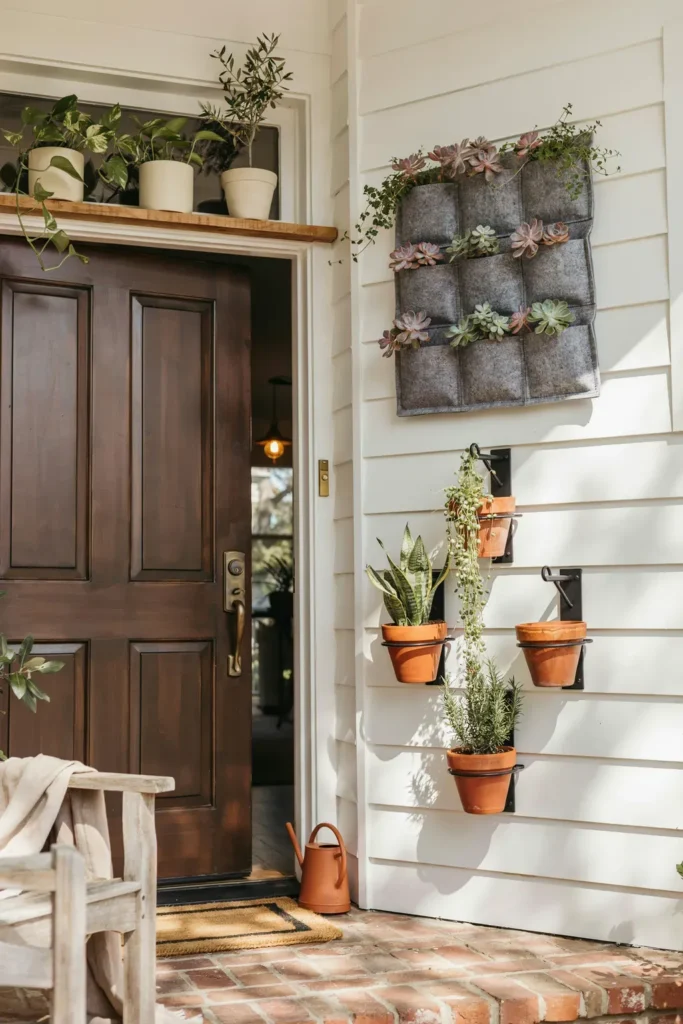
A vertical arrangement of three wall-mounted planters in graduating heights beside the door creates a gallery-wall effect outdoors that is genuinely striking from the street. Vary the plant textures within the arrangement, something trailing at the top, something compact and colourful in the middle, something structural at the base, to create visual movement across the vertical space.
Match wall planter brackets to your door furniture. Matte black brackets suit charcoal and navy doors; aged brass suits warm terracotta and cream exteriors; brushed steel suits contemporary grey and white homes.
5. Step Planters: Use Every Level
A porch with steps has a built-in display system that most people use only for a doormat. Each step offers a planting opportunity, and the staggered heights create a natural vertical layering effect that reads as abundance without requiring significant floor space.
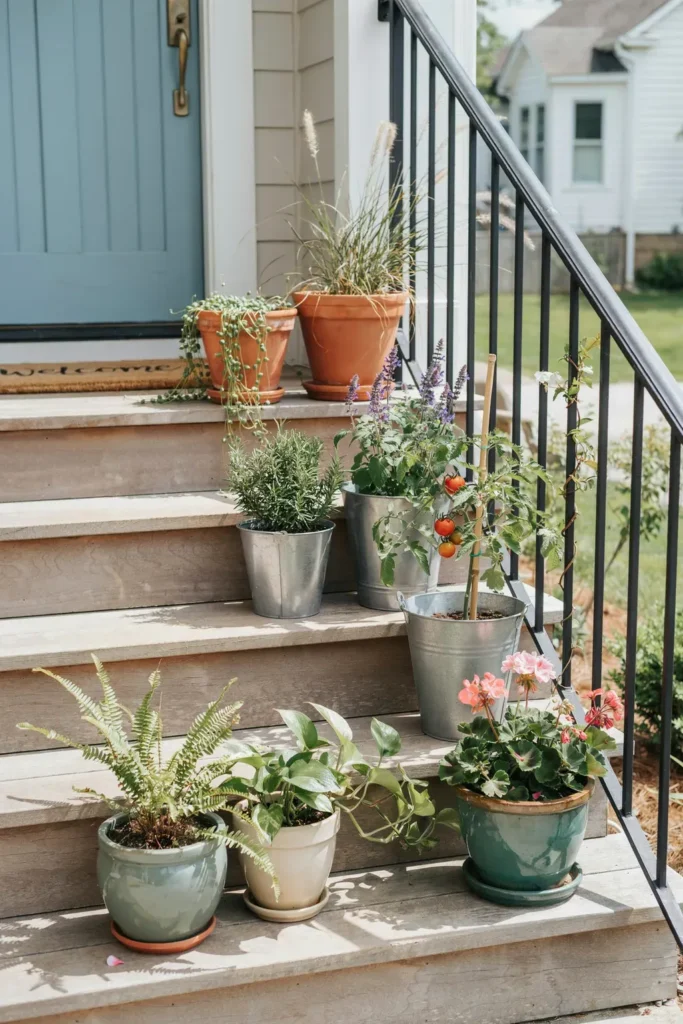
The key is restraint and repetition: one pot per step, all in the same container, arranged in a deliberate line that guides the eye upward toward the door. Or use two steps to create a pair of matching arrangements flanking a central pathway, one on each step on each side, for a symmetrical, formal effect that makes even a modest entrance feel significant.
🏡 Beautiful porch entrance starts at the driveway — see 15 stunning driveway paving ideas for 2026 from large-format pavers to natural stone that create a polished, welcoming approach to your front door:
➤ 15 Driveway Paving Ideas 2026 That Instantly Boost Your Home’s Curb AppealThe pot should be no wider than half the step depth to allow comfortable passage. On narrow steps (under 30cm deep), tall slim planters are the only practical option; wider steps (40cm+) can accommodate a more generous container.
6. Hanging Baskets: Claim the Ceiling
Covered porches, porches with a roof or ceiling structure, cottage aesthetics, hanging baskets are the most space-efficient planting solution available, they float entirely above floor level, leaving the ground completely clear while adding lush, abundant planting at eye level and above. On a small covered porch, two or three hanging baskets create an immersive, flower-filled ceiling that completely transforms the character of the entrance.
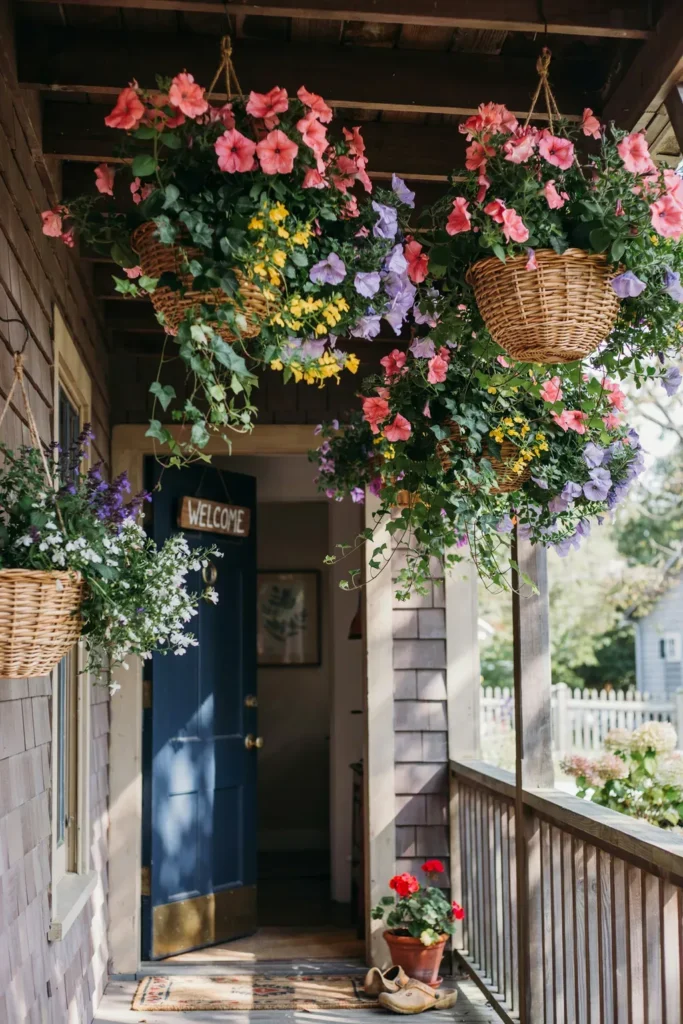
Move beyond the single basket on a hook. Use two baskets at matched heights on either side of the door for symmetry, or three in a row across a porch ceiling for a relaxed, cottage-inspired abundance. Use woven rattan or hammered metal hangers rather than plain plastic chains — the hanger is visible and contributes to the overall aesthetic.
Part Two: What to Plant, Seasonal and Condition Guides for Small Porch Planters
Getting the placement right is only half the equation. The plant choices determine whether your porch looks beautiful in March and in November, in blazing midday sun and in deep overcast shade. Here is the complete seasonal and condition guide.
Front Porch Planter Ideas for Full Sun
A south or west-facing porch that receives 6+ hours of direct sunlight is one of the best conditions for flowering planters — but it demands plants that can handle sustained heat and light without wilting between waterings.
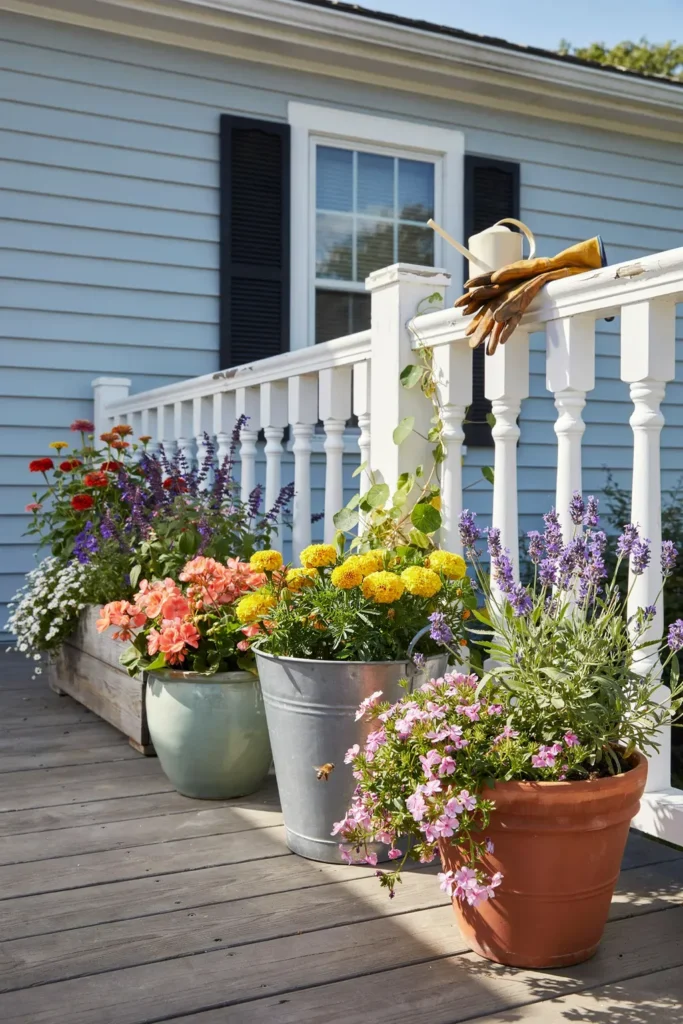
Best plants for full sun small porch planters:
- Pelargoniums (geraniums) — nonstop colour from late spring to first frost, drought-tolerant once established
- Calibrachoa — tiny petunia-like flowers in extraordinary abundance, trailing beautifully over pot edges
- Osteospermum — bright daisy flowers that thrive in heat and light
- Portulaca (moss rose) — thrives in the hottest, driest conditions; stunning in terracotta pots
- Lavender — aromatic, drought-tolerant, evergreen with seasonal flower spikes; ideal for year-round structure
- Salvia — long-blooming, heat-tolerant, and rich in colour from purple through red to white
Light-coloured and thick-walled containers (glazed ceramic, fibreglass, or light terracotta) insulate roots better than dark, thin-walled pots. In full sun, compost dries out rapidly. Use a water-retaining gel mixed into the compost at planting, and consider self-watering containers with built-in reservoirs, which make front porch planter ideas for full sun dramatically easier to maintain through summer.
Front Porch Planter Ideas for Partial Sun
An east or partially shaded porch receiving 3–6 hours of direct sun daily is the most versatile condition for container planting. This middle ground suits a wider range of plants than either full sun or deep shade, including many of the most reliably beautiful cottage and contemporary varieties.
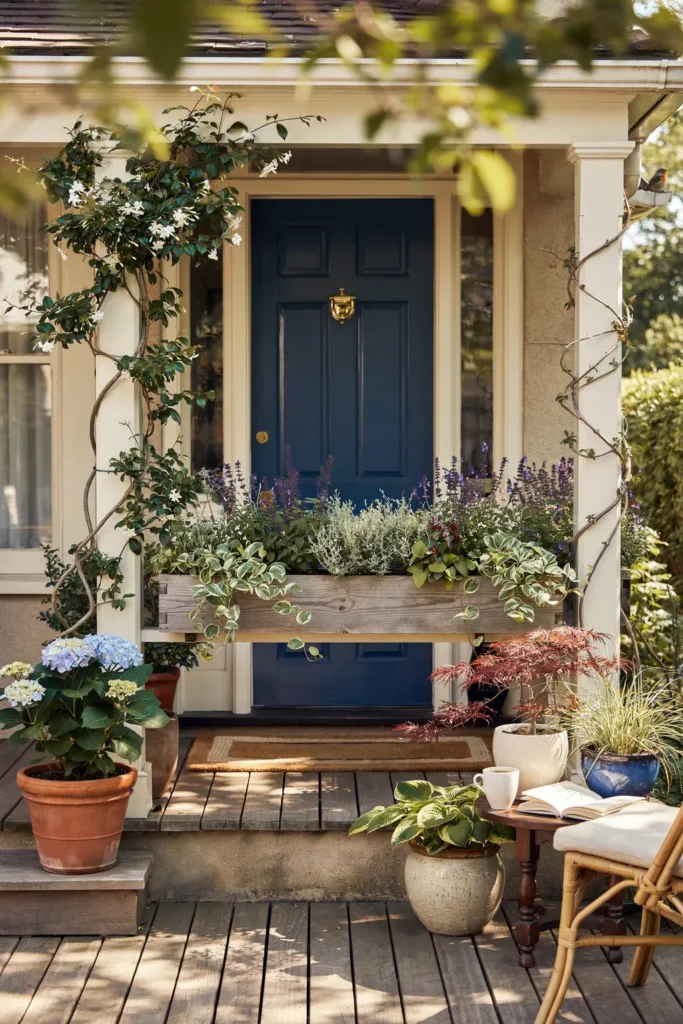
Best plants for partial sun small porch planters:
- Impatiens — one of the most colourful and reliable partial-sun container plants available; available in pinks, reds, whites, corals, and purples
- Fuchsias — pendulous flowers in extraordinary colour combinations that perform beautifully in partial shade
- Begonias — tuberous begonias especially produce spectacular blooms in partial sun conditions
- Violas and pansies — cool-season stars that thrive in 3–5 hours of sun from autumn through spring
- Heuchera (coral bells) — stunning foliage in burgundy, amber, lime, and silver that adds colour without requiring flowering
Partial sun porches often benefit from lighter-coloured pot choices that reflect what light exists and keep the entrance feeling bright and open. A cluster of cream or pale stone planters in a front porch planter ideas partial sun arrangement creates a warm, inviting glow even on overcast days.
Front Porch Planter Ideas for Shade
A north-facing or deeply shaded porch challenges most conventional flowering plants, but the plants that love shade are among the most beautiful and structurally interesting available. The key is embracing the woodland aesthetic rather than fighting it.
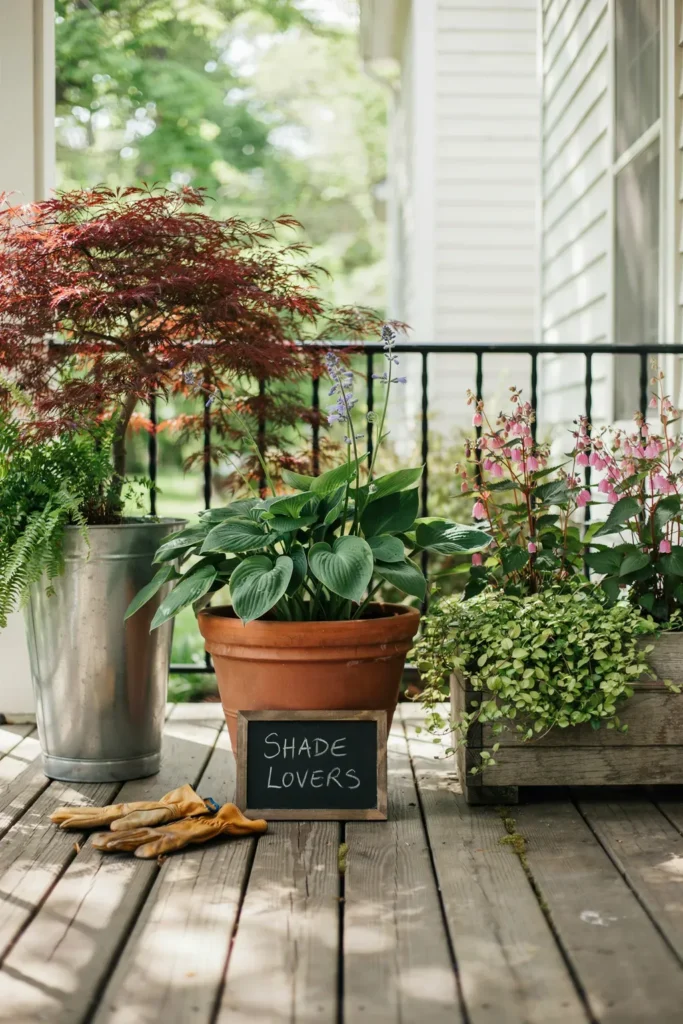
Best plants for shade small porch planters:
- Hostas — extraordinary foliage in gold, blue-green, variegated cream and green; one of the most architecturally beautiful shade plants
- Japanese painted ferns — silver and burgundy fronds that catch whatever light exists and glow against dark backgrounds
- Astilbe — feathery plume flowers in pinks, reds, and white that perform beautifully in shade
- Begonias (wax or fibrous varieties) — reliable flowering colour in shade conditions
- Skimmia japonica — compact, fragrant-flowered evergreen shrub that thrives in shade and berries in winter
- Heucheras — as above; excellent in shade with even better foliage colour than in sun
Styling tip for shade: Light-coloured containers — white, pale stone, cream — reflect available light and prevent a shaded entrance from feeling dark and uninviting. On very shaded porches, a mirror or pair of outdoor lanterns beside the planter can dramatically brighten the visual effect.
Front Porch Planter Ideas for Spring
Spring is the season when front porch planting is most joyful — the combination of emerging bulbs, fresh foliage, and pastel annual colour creates an entrance energy that no other season replicates.
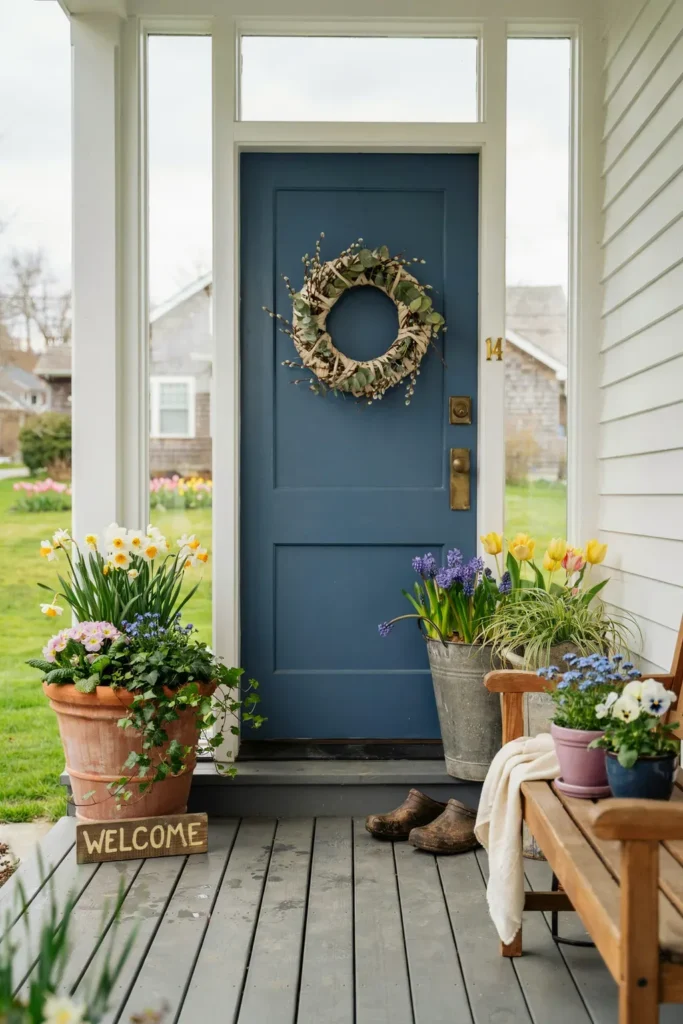
Spring planting strategy for small porches:
Plant tulip, narcissus, and hyacinth bulbs in your porch planters in autumn using the “lasagne” method: deepest-flowering bulbs at the base (tulips), mid-season bulbs in the middle (narcissus), and earliest-flowering bulbs near the top (crocus, snowdrops). This extends your spring display from late winter to late spring without any replanting.
Top-dress with violas, primulas, and trailing ivy in early spring while bulbs are emerging — they fill the gaps, add immediate colour, and are fully cold-hardy.
Terracotta is perfect for spring, its natural warmth suits the season’s colour palette, and its excellent drainage prevents the bulb rot that can occur in non-draining containers.
Pale terracotta pot, white hyacinths rising above trailing blue violas, with a single cream muscari cluster at the edge. Three pots of this combination on steps or a railing creates a spring entrance that looks effortlessly designed.
Front Porch Planter Ideas for Fall
Autumn is one of the most visually rich seasons for front porch styling, and the warm palette of fall lends itself beautifully to compact, statement arrangements that pack maximum colour into limited space.
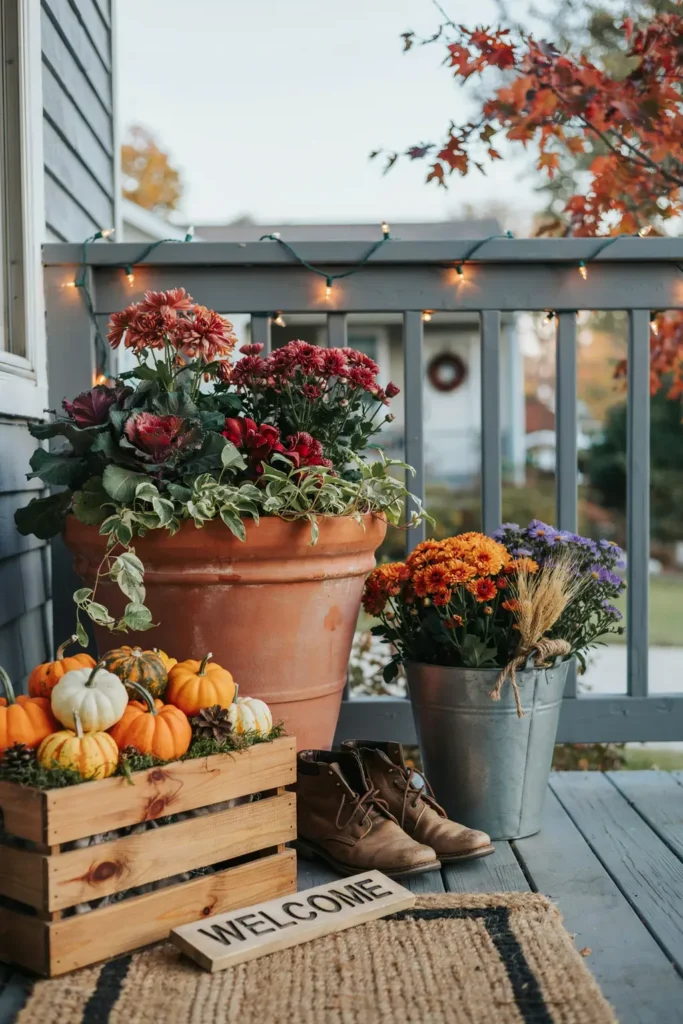
Best plants for fall small porch planters:
- Chrysanthemums (mums) — the signature fall container plant; available in every warm tone from gold through rust to deep burgundy
- Ornamental kale and cabbage — deeply textural rosette foliage in purples, creams, and blue-greens that holds beautifully through the first frosts
- Ornamental peppers — bright jewel-toned fruits in orange, red, yellow, and purple clustered on compact plants
- Trailing sweet potato vine — copper, burgundy, and chartreuse foliage that spills beautifully from compact planters
- Rudbeckia (black-eyed Susan) — warm gold flowers with dark centres that continue from summer into autumn
Add carved or mini pumpkins at the base of your planters to extend the arrangement beyond the containers themselves, a single large planter with two small decorative gourds at its base creates a complete seasonal vignette from very little.
Front Porch Planter Ideas for Winter
Winter is where most small porch planting is simply abandoned, and where a beautifully styled entrance stands out most dramatically against bare, undecorated surroundings. A well-planted winter porch is an act of genuine generosity to everyone who passes by.
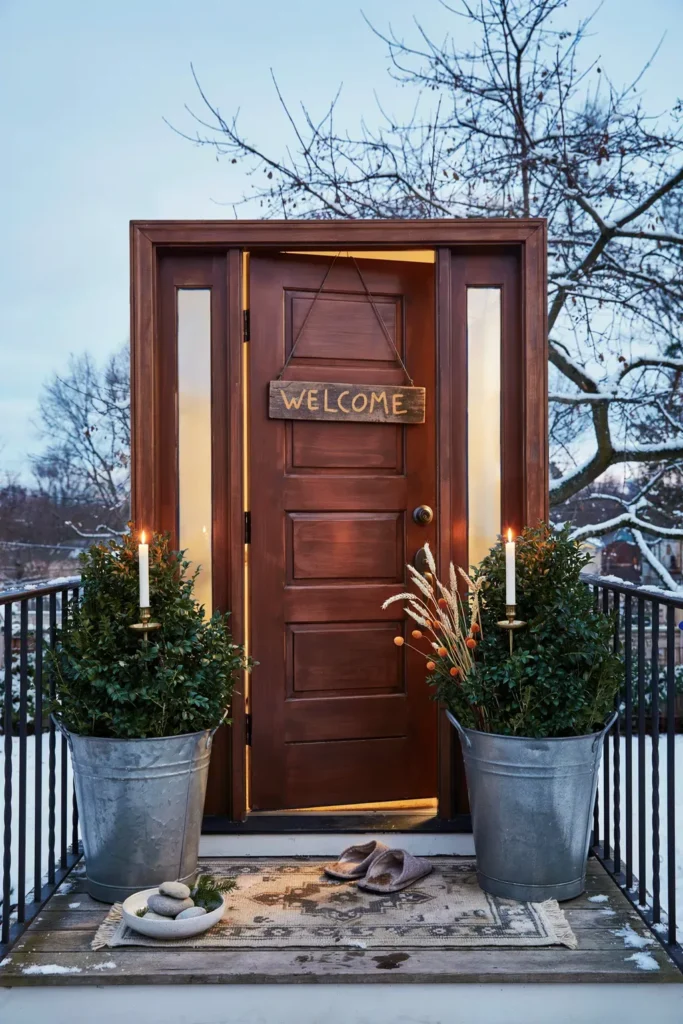
Winter planting strategy for small porches:
The most effective front porch planter ideas for winter combine three elements: structural evergreen, seasonal colour, and decorative interest.
A clipped box ball, dwarf conifer, small bay standard, or skimmia japonica provides form and permanent greenery through the coldest months.
Winter pansies (viola wittrockiana) in deep jewel tones, cyclamen in rich pinks and purples, and winter heathers in white, pink, and mauve all flower reliably through winter and look spectacular against evergreen foliage.
Berry-bearing stems (skimmia berries, holly, rose hips), lichen-covered branches, or a single stem of white birch pushed into the pot beside the plant adds texture and winter character beyond what flowers alone can provide.
A set of warm-white fairy lights wound through a winter porch planter creates a beautiful entrance after dark, arguably the most important time during the short, dark days of winter. For a small porch, a single lit planter beside the door creates a disproportionate impact at very low cost.
Front Porch Planter Ideas Year Round
The gold standard for any small porch is an arrangement that never looks bare or neglected — one that evolves gracefully across all twelve months without requiring a complete replant each season.
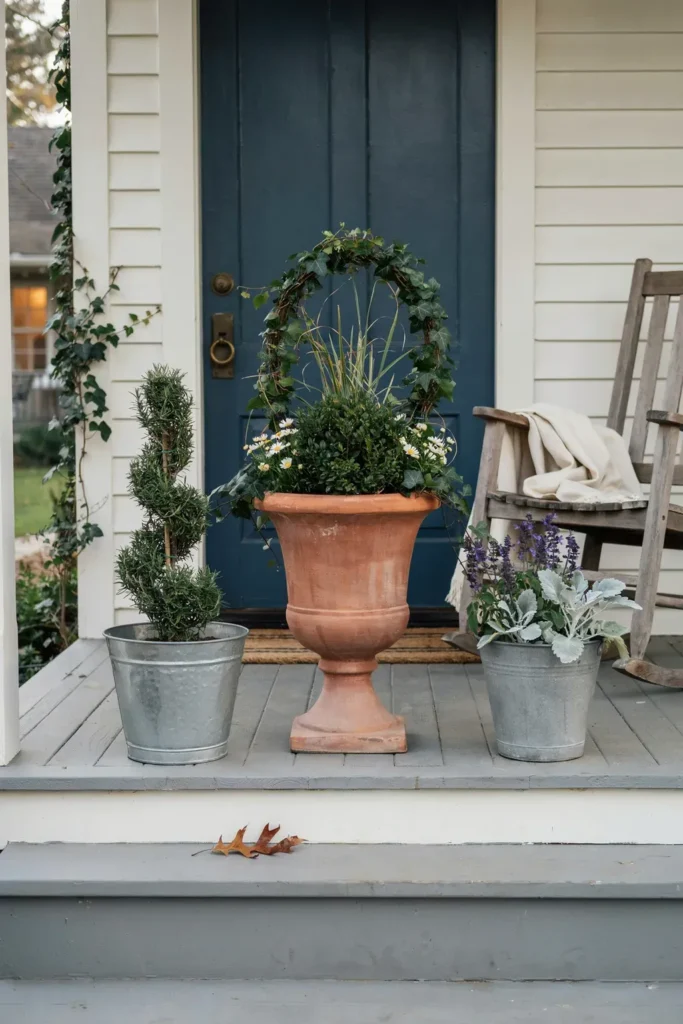
The year-round small porch planter system:
For a small porch with one or two planters, use this three-layer approach in each container:
Layer 1 — Permanent structure (never changes): One evergreen specimen per planter. Clipped box ball, dwarf conifer, standard bay, or ilex crenata. This provides form and greenery in every month of the year.
Layer 2 — Semi-permanent trailing (changes 1–2 times per year): Trailing ivy, vinca minor, or trailing euonymus grows around the base of the structural plant and softens the container edge through all seasons. Replace in spring and autumn if needed.
Layer 3 — Seasonal colour plug-ins (changes 3–4 times per year): Spring — bulbs and violas. Summer — geraniums, calibrachoa, or impatiens (depending on sun). Autumn — mums, ornamental kale. Winter — cyclamen and winter pansies.
Each seasonal replant takes under 30 minutes per planter and completely transforms the entrance feel — while the permanent structure means the porch never looks bare or unfinished between seasonal changes.
Front Porch Planter Ideas: Evergreen Options
Evergreen planters deserve their own section because they are simultaneously the most low-maintenance and the most architecturally powerful option for a small porch — particularly for entrances that need to look beautiful year-round with minimal seasonal attention.
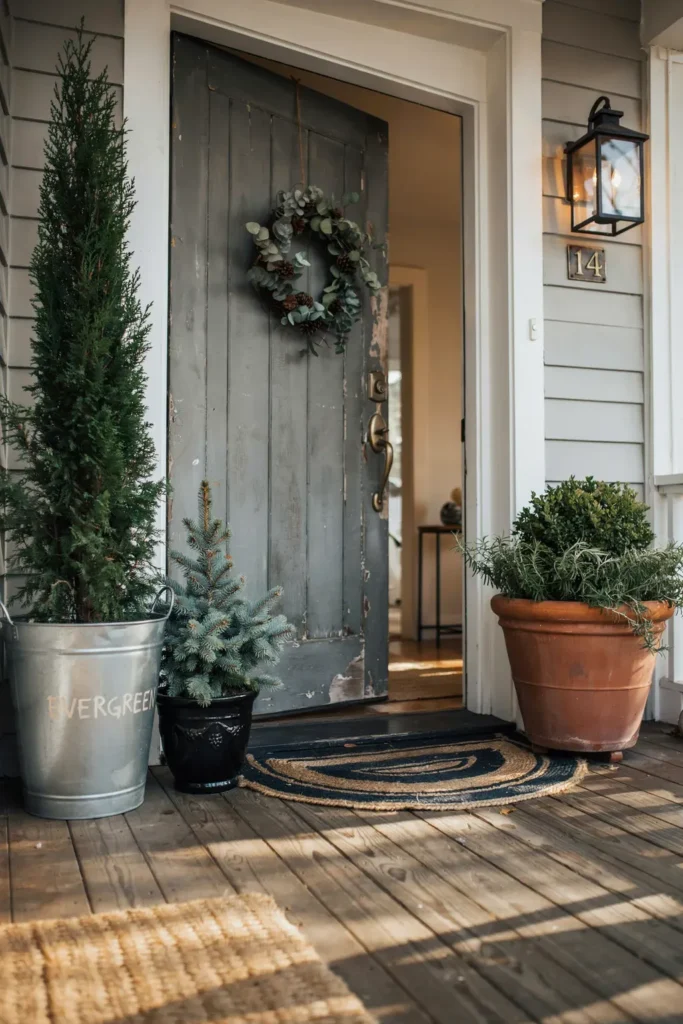
The best evergreen plants for small porch planters:
Box (Buxus sempervirens) — the classic clipped topiary choice; ball, cone, or spiral forms all suit entrance planters. Note: choose ilex crenata or euonymus japonicus as box blight-resistant alternatives.
Bay standard (Laurus nobilis) — the most elegant evergreen porch plant; a clipped lollipop or cone of bay beside a painted front door is a timeless combination that works in every style from cottage to contemporary.
Fatsia japonica — large, architectural, deeply lobed leaves that add a tropical boldness to shaded or partial-shade entrances; evergreen and extremely tolerant.
Camellia — evergreen glossy leaves with spectacular winter and spring flowers; one of the few plants that gives you year-round foliage structure and seasonal flowering beauty.
Dwarf conifers — compact, slow-growing, and available in a huge range of shapes (globe, cone, columnar) and foliage colours (green, blue-grey, gold).
Pro styling tip for evergreen small porch planters: A pair of matching evergreen specimens flanking a front door is one of the most powerful front porch planter ideas entrance moves available — it creates permanent structure that frames the door beautifully in every season and requires only occasional watering and an annual clip to maintain.
Front Porch Planter Ideas with Fake Plants
For small porches in deep shade, extreme weather conditions, rental properties, or homes with owners who travel frequently, high-quality artificial plants have become a genuinely practical and visually convincing option — provided they are chosen and styled with care.
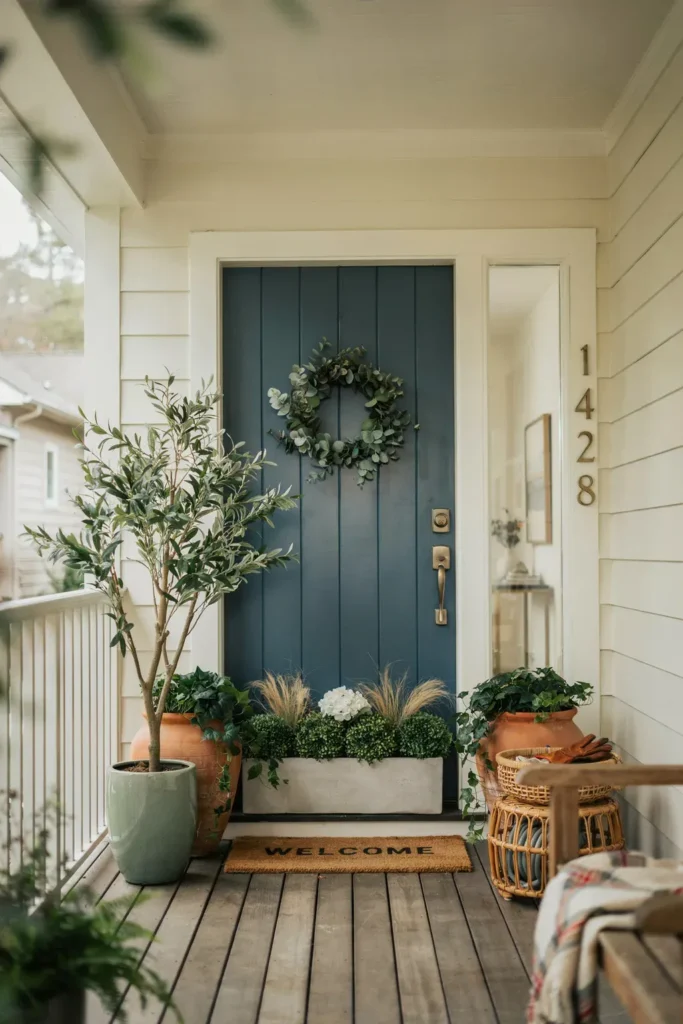
What makes fake porch planters look convincing:
Quality is non-negotiable. Cheap artificial plants look obviously fake from ten feet away. Premium UV-stabilised artificial foliage with realistic colour variation, textural imperfection, and natural-looking stem structure can be convincingly difficult to distinguish from real plants at front-door distance.
Best artificial plants for small porch planters:
- Faux boxwood balls — the most convincing and widely used artificial porch plant; choose a premium grade with varied foliage tones
- Artificial lavender — realistic stem structure and convincing purple flower spikes
- Faux trailing ivy — works beautifully as a flowing base layer around a more structured centrepiece
- Artificial succulents and agaves — their natural geometry translates well to artificial versions
- UV-resistant mixed foliage arrangements — designed specifically for outdoor use
Styling rules for fake plant porch planters:
- Use UV-resistant outdoor-rated artificial plants only — indoor artificial plants fade, yellow, and deteriorate rapidly in outdoor conditions
- Choose planters with drainage holes so water does not pool visibly
- Mix artificial plants with real gravel mulch, bark chips, or natural stone at the soil surface — the real textural elements add authenticity to the overall arrangement
- Replace or refresh every one to two seasons — even quality outdoor artificial plants lose their convincing quality after extended UV exposure
A single large, high-quality artificial boxwood ball in a statement concrete or ceramic planter is the most convincing fake plant approach for a small porch, and more believable than a complex multi-species arrangement of lower-quality pieces. Simplicity and quality always wins.
Front Porch Planter Ideas: Modern Style for Small Spaces
For contemporary homes, new builds, renovated Victorian terraces with sleek interiors, minimalist apartments, the modern aesthetic applied to small porch planting is one of the most striking approaches available.
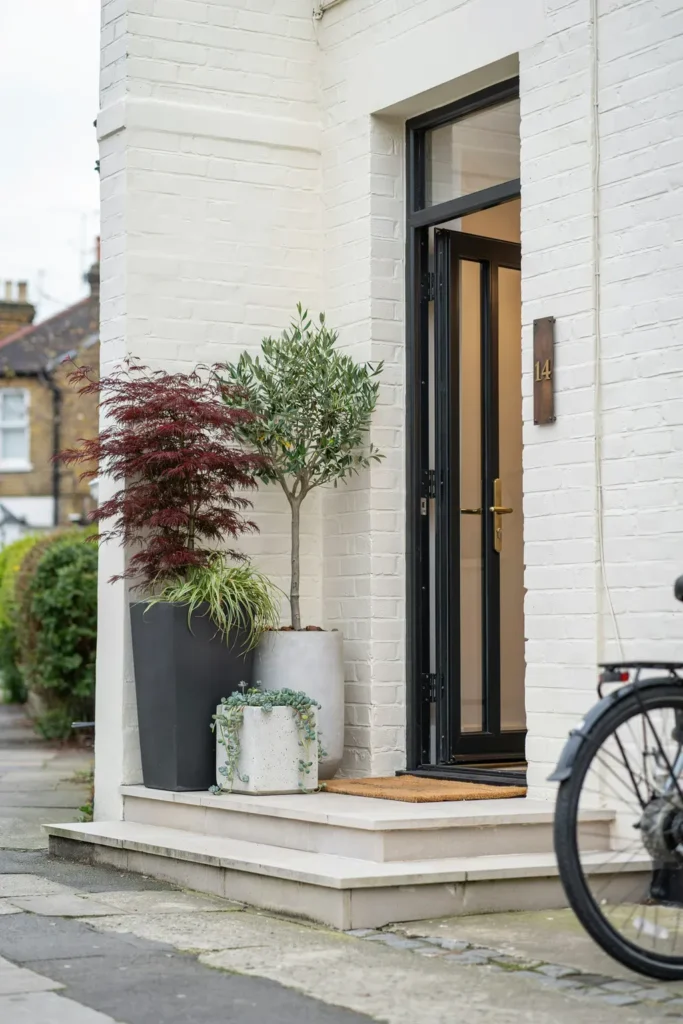
The modern small porch planter formula:
Modern front porch planter ideas are defined by restraint, material quality, and architectural plant choices. The goal is a porch that looks like a landscape architect designed it, not fussy, not floral, not traditional.
Container choices for modern small porches:
- Large-format concrete cylinders or cubes in raw or smooth finish
- Tall fibreglass planters in matte black, graphite, or deep navy
- Rectangular corten steel troughs (a single long trough on a step is a distinctive modern move)
- Oversized glazed ceramic in deep teal, charcoal, or smoke grey
Plant choices for modern small porches:
- Phormium (New Zealand flax), bold, strappy leaves in dark burgundy, bronze, or striped varieties; powerfully architectural
- Ornamental grasses — Carex ‘Evergold’, Festuca glauca, or Pennisetum for movement and texture
- Agave or architectural succulents — geometric form and year-round interest
- Single-stem standard trees — clipped lollipop bays, standard roses, or standard euonymus in a tall pot
Modern small porch planters work best when the arrangement feels deliberately spare — two elements done exceptionally well rather than five elements competing. Breathing space is a design feature, not empty space.
The Small Porch Planter Quick-Start Checklist
Not sure where to begin? Use this checklist to make your first decisions:
Step 1 — Assess your sun: Count the hours of direct sun your porch receives on a typical summer day. Under 3 hours = shade. 3–6 hours = partial sun. Over 6 hours = full sun. This determines your plant palette before anything else.
Step 2 — Measure your floor space: Note the exact width and depth available beside or around your door. This determines whether a single statement planter, a pair of column planters, or a wall/rail approach is most appropriate.
Step 3 — Choose one aesthetic: Cottage, modern, Mediterranean, minimal, or classic. Pick one and commit. Mixed aesthetics are the most common reason small porch arrangements fail visually.
Step 4 — Select a container, then a plant: Always choose the container first. Its material, colour, and form set the aesthetic parameters; the plant fills within them.
Step 5 — Plan all four seasons: Before buying anything, sketch out what the planter will hold in spring, summer, autumn, and winter. A year-round plan makes your entrance look intentional year-round.
Frequently Asked Questions
What is the best single planter idea for a very small front porch?
One large, statement-scale container in a premium material — concrete, glazed ceramic, or fibreglass — planted with a single architectural evergreen and one trailing variety. Positioned beside the door with confidence, this is the approach that consistently looks the most deliberately designed on compact porches.
Can I have colour year-round on a small porch without replanting constantly?
Yes — using the three-layer system (permanent evergreen + semi-permanent trailing + seasonal colour plug-ins) means you only need to change the top seasonal layer three to four times per year, which takes under 30 minutes per planter. The permanent and semi-permanent layers keep the planter looking full and structured between seasonal changes.
What are the best front porch planter ideas for a small porch in full shade?
Hostas, Japanese ferns, begonias, skimmia, and heucheras all produce beautiful container arrangements in full shade. Use light-coloured pots to maximise reflected light, and add outdoor lighting near the planter to ensure it is visible and beautiful after dark — when most people arrive home.
Do fake plants look convincing on a front porch?
Premium UV-stabilised outdoor artificial plants in simple forms — a faux boxwood ball, artificial lavender, or trailing faux ivy — can look convincing at front-door distance, especially when combined with real gravel or bark mulch on the compost surface. The key is outdoor-rated quality and simple plant choices. Complex multi-species arrangements of lower-quality artificial plants rarely convince.
How do I stop small porch planters from looking cluttered?
Single consistent pot colour or material across all containers, a unified planting palette of two to three plant colours, and deliberate use of negative space (not every inch needs to be filled) are the three most effective solutions. If the arrangement feels crowded, remove one element, you will almost always find the edited version looks more intentional and refined.
Final Thoughts
A small porch styled with intention will always outperform a large porch treated as an afterthought. The constraint of limited space is precisely what creates the discipline that makes small porch planting so satisfying, every decision matters, every element contributes, and the finished result rewards that precision with an entrance that looks genuinely composed rather than accumulated.
Whether you take the clean modern route of a single statement planter in matte concrete, build a year-round layered system around a pair of evergreen bay standards, or create a lush cottage entrance with rail planters trailing over cascading foliage — the approach that works best is always the one applied with consistency, confidence, and a clear seasonal plan.
Save this guide to return to with each season, and share it with anyone whose front door deserves a little more thought. Because a beautiful entrance is one of the most generous things a home can offer, and it takes far less space than most people think.