
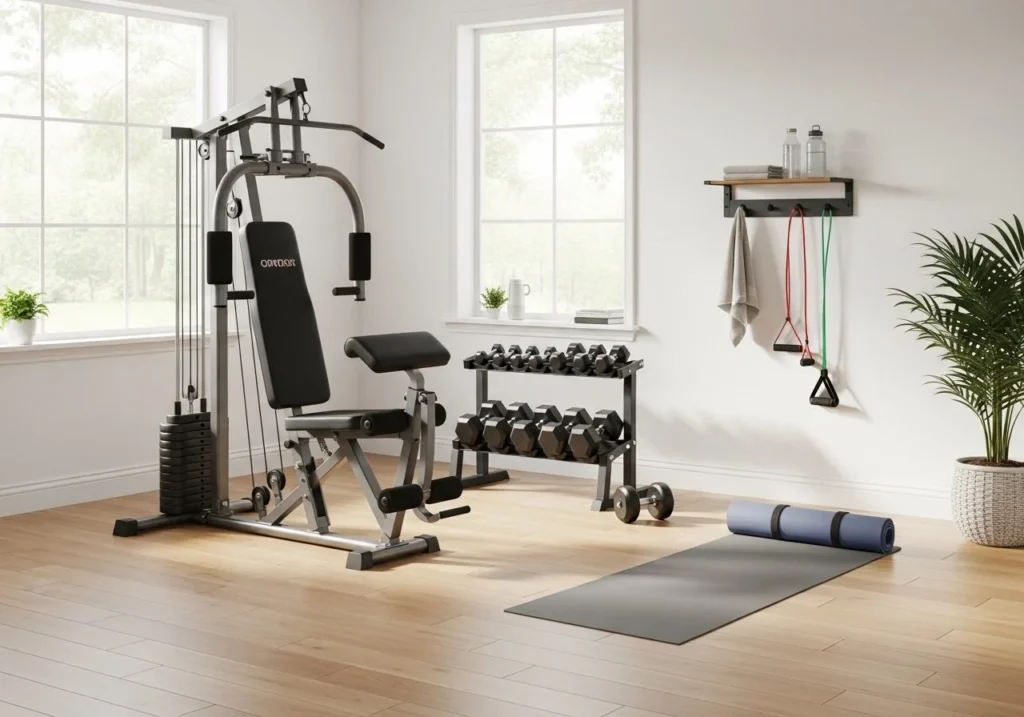
You don’t need a dedicated gym room to build a consistent fitness habit at home. With a bit of creativity and smart space planning, even the smallest apartment or house can support a practical and motivating workout setup. Here are 21 mini gym at home ideas that prove fitness doesn’t require a lot of space — just the right approach.
1. Foldable Yoga Mat Zone
Designate a small corner of any room as your yoga and stretching zone. A foldable or rollable mat takes up almost no space when not in use and gives you a dedicated, defined area for stretching, yoga, and bodyweight exercises. Add a small basket nearby for resistance bands and blocks.
2. Resistance Band Wall Hook
Mount a simple hook or small pegboard near a wall to hang resistance bands of different strengths. This keeps them visible, organized, and accessible — no digging through drawers before a workout. Resistance bands are one of the most space-efficient pieces of fitness equipment, offering a full-body workout in a package that weighs almost nothing.
3. Under-Bed Dumbbell Storage
Adjustable dumbbells or a small set of fixed weights can slide neatly under most bed frames on a low-profile storage tray or in a shallow bin. This keeps heavy equipment out of sight and off the floor while keeping it accessible for a quick morning workout. Add a mat that you can pull out alongside them.
4. Doorway Pull-Up Bar
A doorway pull-up bar installs in seconds with no tools and no wall damage, and stores in a closet when not in use. It’s one of the best investments for a mini home gym — enabling pull-ups, chin-ups, hanging core exercises, and even resistance band work. Choose a standard-width doorframe in a high-traffic area so you’re reminded to use it regularly.
5. Corner Cardio Jump Rope Spot
Clear a small corner with enough overhead clearance for a jump rope and you’ve got a surprisingly effective cardio station. Jump rope is one of the most efficient forms of cardiovascular exercise, and all it requires is a few square feet. A speed rope hangs on a hook and takes up essentially no space.
6. Adjustable Kettlebell Nook
An adjustable kettlebell replaces an entire rack of single-weight kettlebells by allowing you to change the weight with a simple dial. Place it in a small basket, on a low shelf, or in a corner with your mat, and you have a compact strength station that covers squats, swings, deadlifts, and presses.
7. Fold-Down Wall Bench
A fold-down workout bench that mounts flush to the wall and folds up out of the way when not in use is a game-changer for small home gyms. It enables incline presses, step-ups, tricep dips, and core work — without taking up permanent floor space. When folded up, it looks like a sleek wall panel.
8. Mirror Fitness Corner
Installing a full-length mirror in your workout area serves two purposes: it makes the space feel larger and allows you to check and correct your form during exercises. A leaner mirror propped against a wall or a wall-mounted mirror panel both work well. Combined with good lighting, a mirrored wall transforms a corner into something that actually feels like a gym.
9. Storage Ottoman Gym Hack
A sturdy storage ottoman can double as workout equipment — use it for step-ups, tricep dips, box squats, or plyometric box jumps. It stores bands, a mat, and small accessories inside, and when you’re done, it goes right back to being living room furniture. A win-win for small-space living.
10. Balcony Micro Gym
If you have even a small balcony or outdoor space, it can become your most motivating workout area. A mat, a kettlebell, and a jump rope are all you need. Working out in fresh air with natural light is a significant upgrade in both motivation and experience. Store equipment inside a waterproof storage box when not in use.
11. Compact Step Platform
An aerobic step platform provides height options for step exercises, incline push-ups, elevated foot work, and balance training. Most models stack into a slim profile for storage in a closet or under a bed. Combined with resistance bands and a mat, it rounds out a compact but complete cardio and strength setup. Speaking of storage, these closet organization ideas can help you carve out a tidy spot for all your compact gym equipment.
12. Resistance Slider Floor Setup
Sliders — small discs you place under your hands or feet on smooth floors — enable a surprisingly intense low-impact workout. Mountain climbers, lunges, pikes, and hamstring curls all become dramatically more challenging with sliders. They cost almost nothing and store in a drawer or coat pocket.
13. Wall-Mounted Equipment Rack
Even in a small home gym setup, a wall-mounted rack keeps things organized and off the floor. Mount simple hooks or a small multi-arm rack to hold kettlebells, bands, foam rollers, and jump ropes. Everything in one place, nothing underfoot — a tidy gym is a gym you actually use.
14. Chair-Based Workout Station
A sturdy dining or desk chair is surprisingly useful for working out. It provides a surface for tricep dips, elevated push-up handles, seated core work, and stability exercises. If you work from home, adding a few chair-based exercises into your day makes the most of equipment you already have. For ideas on setting up a productive at-home workspace around your chair, check out these home office interior design ideas.
15. Mini Foam Roller Recovery Station
Recovery is as important as the workout itself. A compact foam roller and a small lacrosse ball for trigger-point work can be stored in a small bin near your mat. Creating a small dedicated recovery area — even just a mat corner — reinforces the habit of post-workout stretching and rolling.
16. Foldable Treadmill Storage
If you want a cardio machine at home, a folding treadmill is the space-smart choice. Modern folding treadmills have a slim, upright profile when stored and can be tucked into a closet or against a wall between uses. Pair with good headphones and your favorite streaming service for effective indoor cardio any time.
17. Desk-to-Gym Transition Area
If your home office and home gym share the same room, design the transition between them intentionally. A rolling mat that slides from under the desk, a hook for resistance bands next to the monitor, or a small ottoman that shifts from footrest to step platform makes it easy to pivot from work mode to workout mode without leaving the room. These small office design ideas offer clever space-sharing solutions that keep both functions organized.
18. Minimalist TRX Strap Setup
TRX suspension straps hook over a door, a pull-up bar, or a sturdy wall anchor and enable a full-body strength training routine using your own bodyweight. The entire system folds into a small bag. It’s one of the most effective space-to-workout-variety ratios of any piece of fitness equipment available.
19. Living Room Night Gym
Your living room becomes a surprisingly functional gym after the furniture is pushed back. Roll out a mat, hang a band on the door frame, and you’re set. The key to making this work is keeping your equipment in an accessible basket or bin near the living room — not buried in a closet — so setup and breakdown take under 60 seconds.
20. Closet Gym Conversion
An underused closet can be transformed into a compact home gym with the right setup. Remove the rod, install wall-mounted hooks for bands and jump rope, add a fold-down shelf for a mat and weights, and mount a mirror on the back of the door. When you’re done, close the door and your living space is instantly reclaimed.
21. One-Tool Workout Rule
The best mini home gym strategy is often the simplest: pick one versatile piece of equipment and master it. A kettlebell, a set of resistance bands, or a TRX strap can deliver a comprehensive, full-body program without additional tools. Limiting yourself to one tool eliminates decision fatigue, reduces equipment clutter, and forces creative, effective programming.
Final Thoughts
Building a mini gym at home is less about how much space you have and more about how intentionally you use it. With a few key pieces of equipment, smart storage, and a dedicated workout area — even a small corner — you can build a consistent fitness routine without ever leaving home. Start small, stay consistent, and add equipment only as you outgrow what you have.