
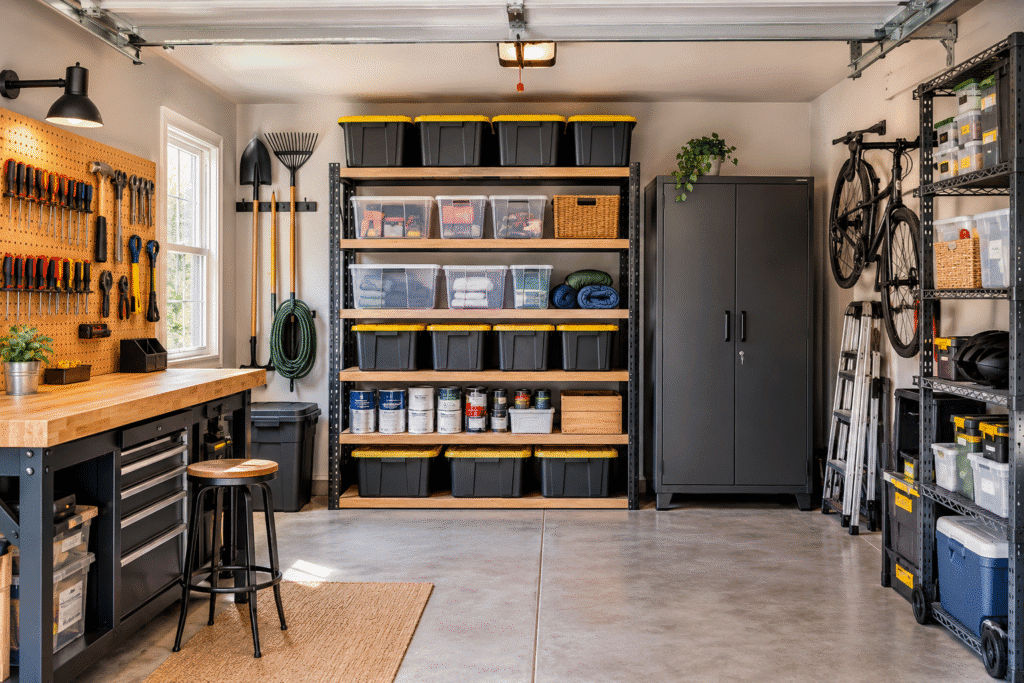
A small garage forces a different kind of thinking than a full workshop setup. There is no extra wall to spare, no room for a second workbench, and every square foot has to justify itself especially if you still want to park a car inside. The good news is that most small garages are not actually out of space. They are out of organized space, with a lot of it sitting unused overhead, behind doors, and along walls that never get touched.
These 23 hacks focus specifically on tight garages, where the goal is not building out a full workshop but making the most of a compact footprint. If you are working with more square footage and want a complete organizational overhaul, start with our garage organization ideas guide, or if your garage doubles as a workspace, see our garage workshop setup ideas for layout and station tips.
Why Small Garages Need a Different Approach
Contents
- 1 Why Small Garages Need a Different Approach
- 2 Vertical and Overhead Storage Hacks
- 3 Wall-Mounted System Hacks
- 4 Underused Space Hacks
- 5 Furniture and Container Hacks
- 6 Zoning and Access Hacks
- 7 Materials and Tools You’ll Need
- 8 Maintaining a Small Garage Storage System
- 9 Small Garage Storage by Situation
- 10 Budget-Friendly vs. Higher-Investment Small Garage Hacks
- 11 Common Small Garage Storage Mistakes to Avoid
- 12 Quick 23-Point Small Garage Storage Checklist
- 13 Small Garage Storage Hacks for Renters
- 14 A Sample Small Garage Transformation
- 15 Small Garage vs. Large Garage: What Actually Changes
- 16 Frequently Asked Questions
- 17 Final Thoughts
A one-car or shared-use garage cannot rely on the same strategies as a large detached workshop. Floor space is the most valuable and most limited resource, so nearly every hack below is built around one rule: get things up, off, or against the walls, and keep the middle of the garage clear.
| Common Small Garage Problem | What Usually Causes It |
|---|---|
| Cannot fit the car inside | Floor-level clutter and boxes stacked in the parking zone |
| No room for a workbench | Storage systems that only use wall space at eye level |
| Seasonal items block daily-use items | No dedicated overhead or rotational storage |
| Bikes and sports gear pile up | No vertical or hanging system for oddly shaped items |
| Nothing has a “home” | Bins and shelves added without a category system |
Before diving into individual hacks, it can help to sketch your garage’s actual dimensions and test a layout on paper. Our Room Layout Planner tool makes it easy to map out where storage should go before you buy anything.
Vertical and Overhead Storage Hacks
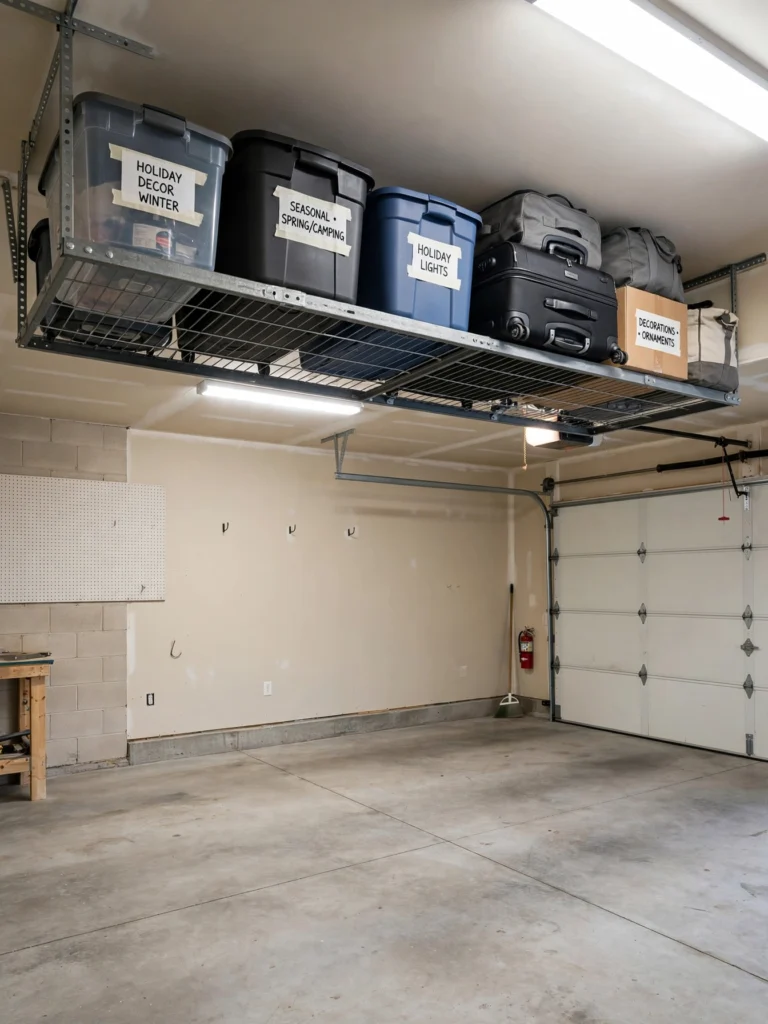
1. Install a Ceiling-Mounted Storage Platform
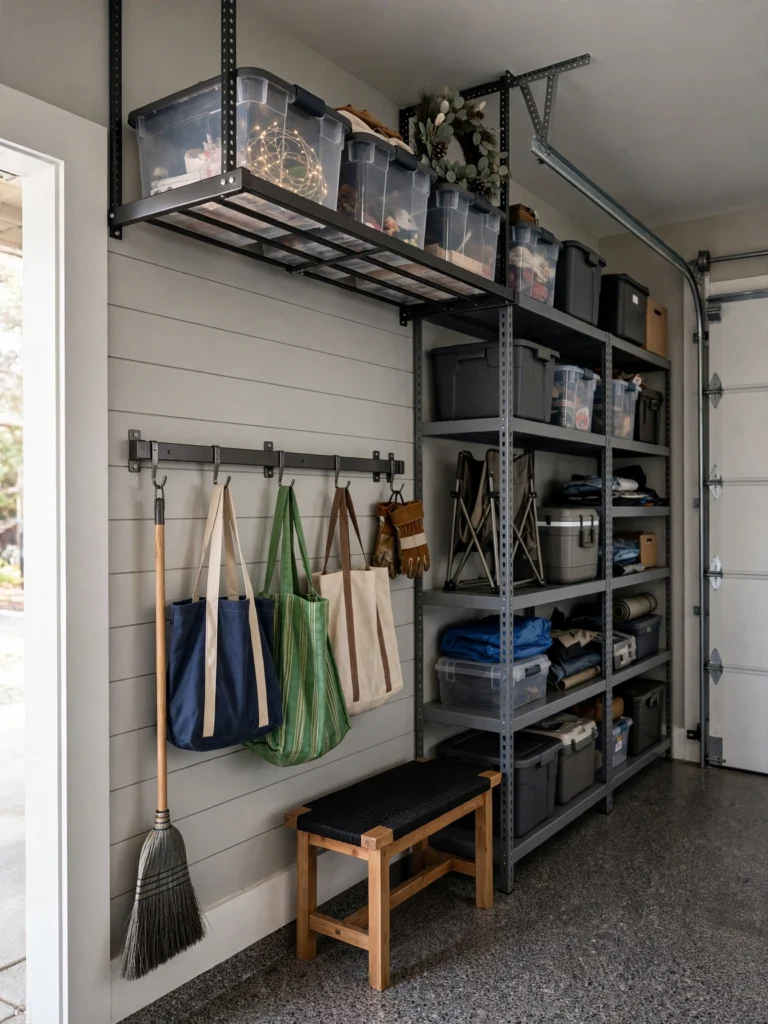
A simple platform rack installed near the ceiling can hold seasonal bins, luggage, or rarely used equipment completely out of the way, freeing up an entire section of floor or wall space below it.
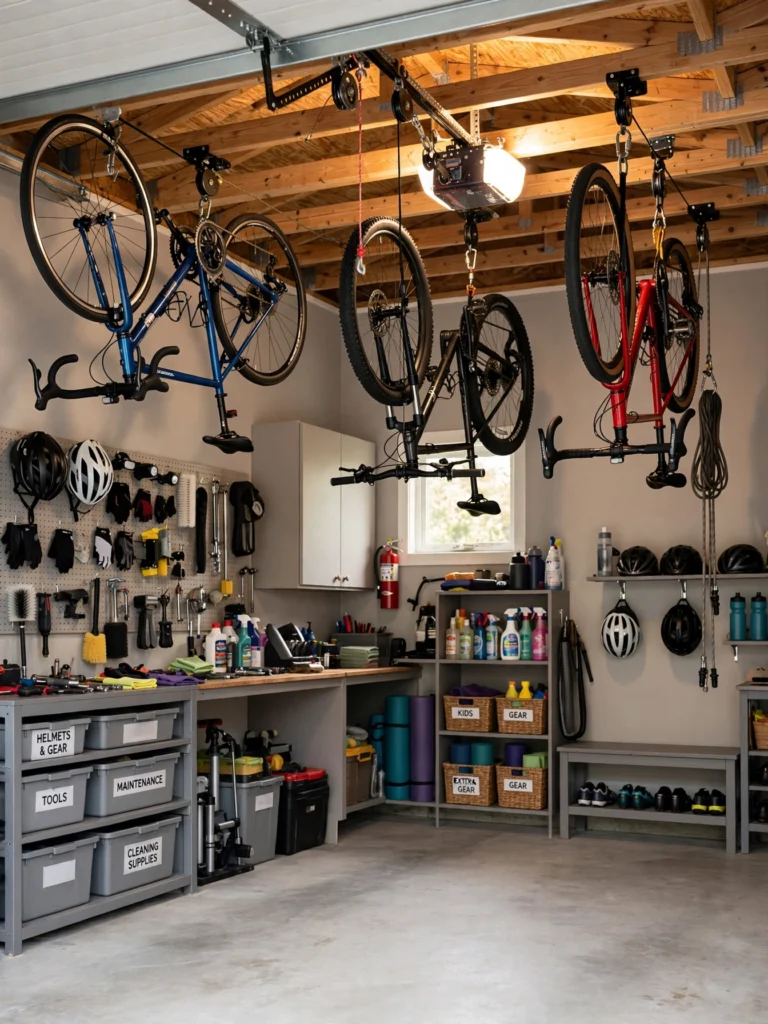
2. Add a Bike Pulley or Hoist System
Bikes take up an awkward amount of floor space for their size. A ceiling-mounted pulley system lifts bikes straight up and out of the way, which is one of the highest-impact hacks for garages with multiple riders in the household.
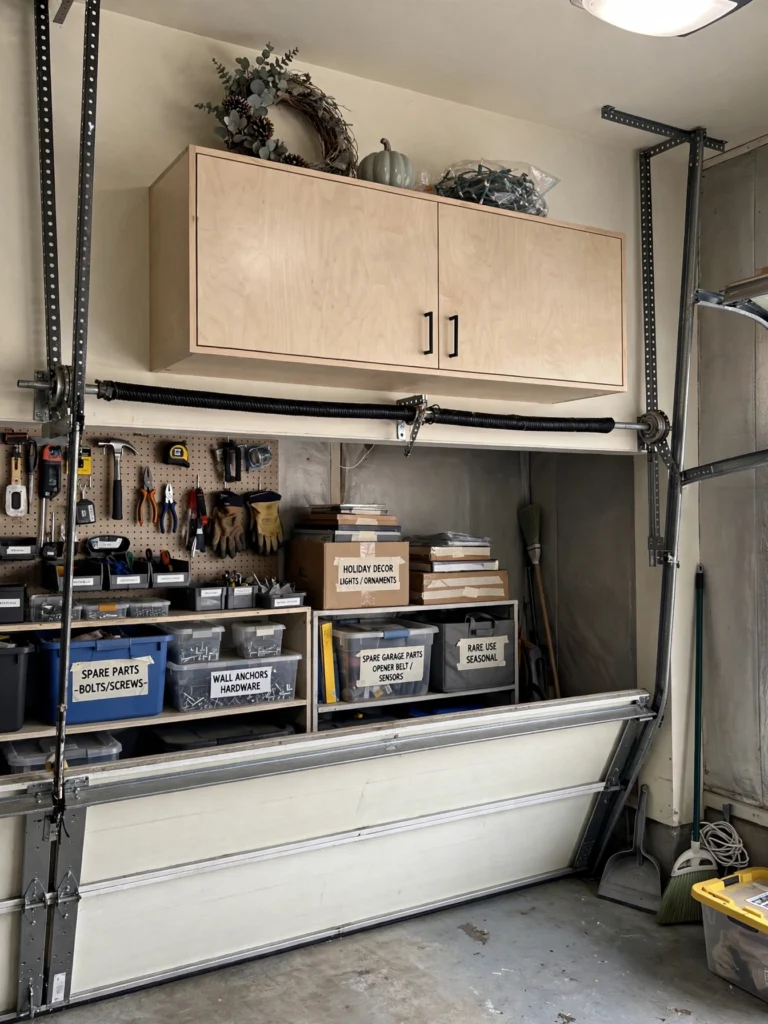
3. Use the Space Above the Garage Door
The wall area above where the garage door track ends is almost always empty. A shelf or shallow cabinet mounted here is perfect for lightweight, rarely accessed items like decorations or spare parts.
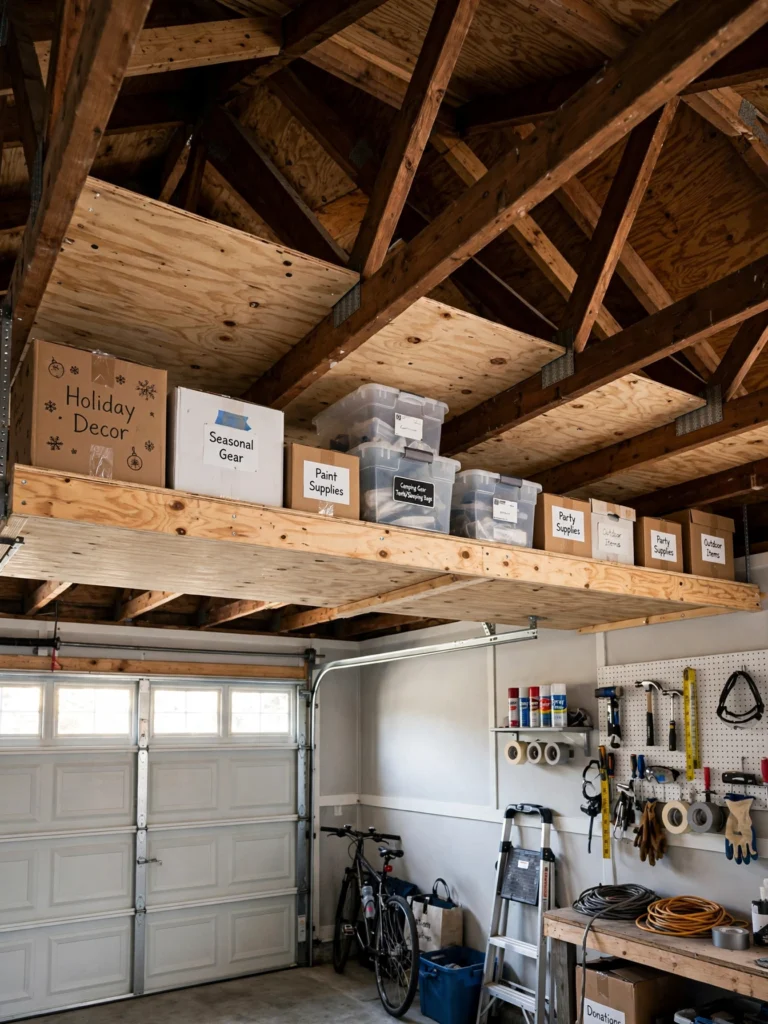
4. Install Overhead Rafter Storage
If your garage has exposed rafters or trusses, a few sheets of plywood laid across them (properly secured) create a simple attic-style storage shelf for lightweight boxes.
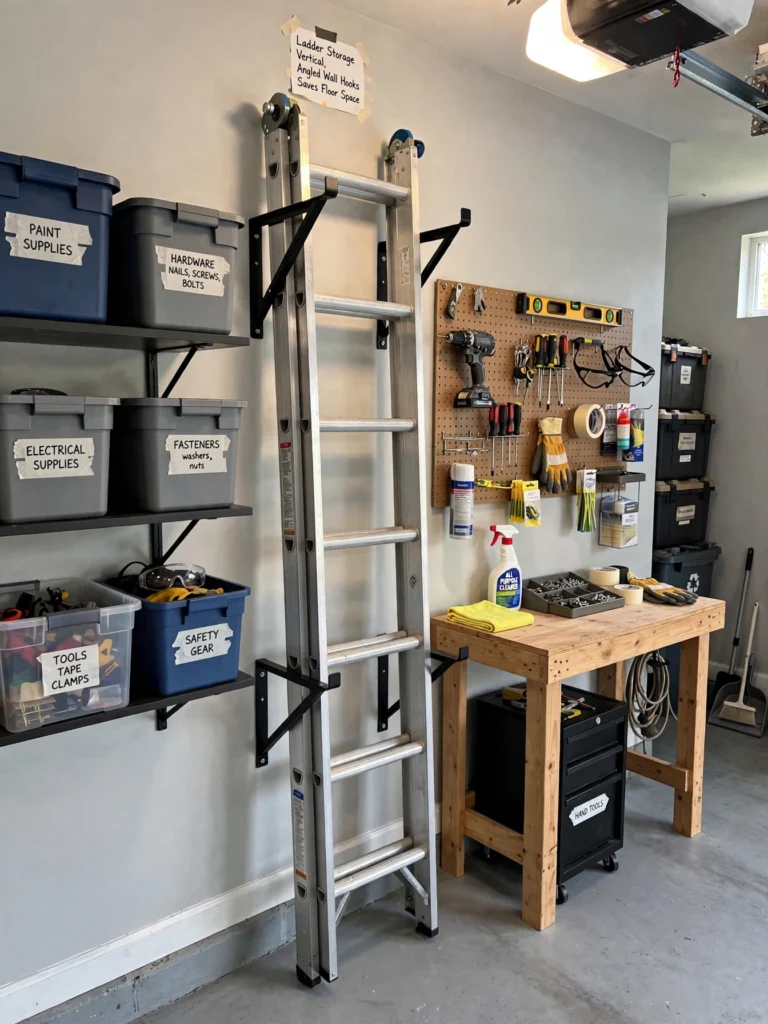
5. Add a Wall-Mounted Ladder Rack
Ladders are awkward to store flat or leaned against a wall, where they take up valuable floor space. A pair of angled wall hooks keeps a ladder flush against the wall, vertically, using almost no floor footprint.
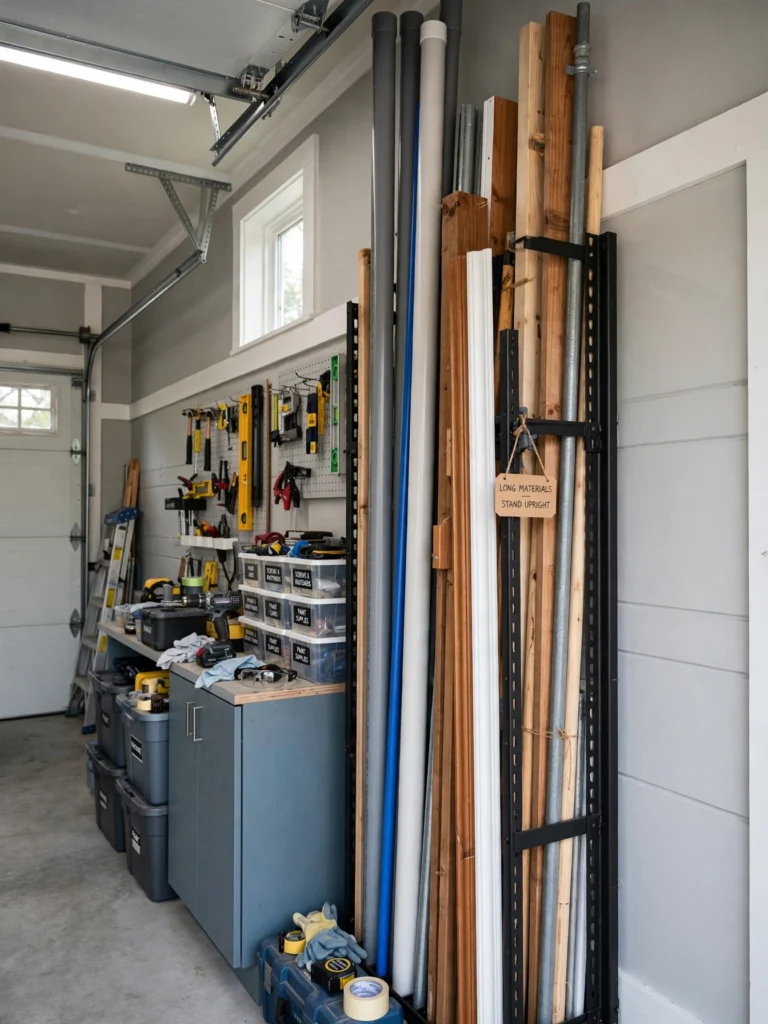
6. Use Vertical Lumber or Long-Item Racks
Long items like pipes, trim, or spare wood are easiest to store standing upright in a narrow vertical rack rather than laid flat, where they take up disproportionate floor space.
Wall-Mounted System Hacks
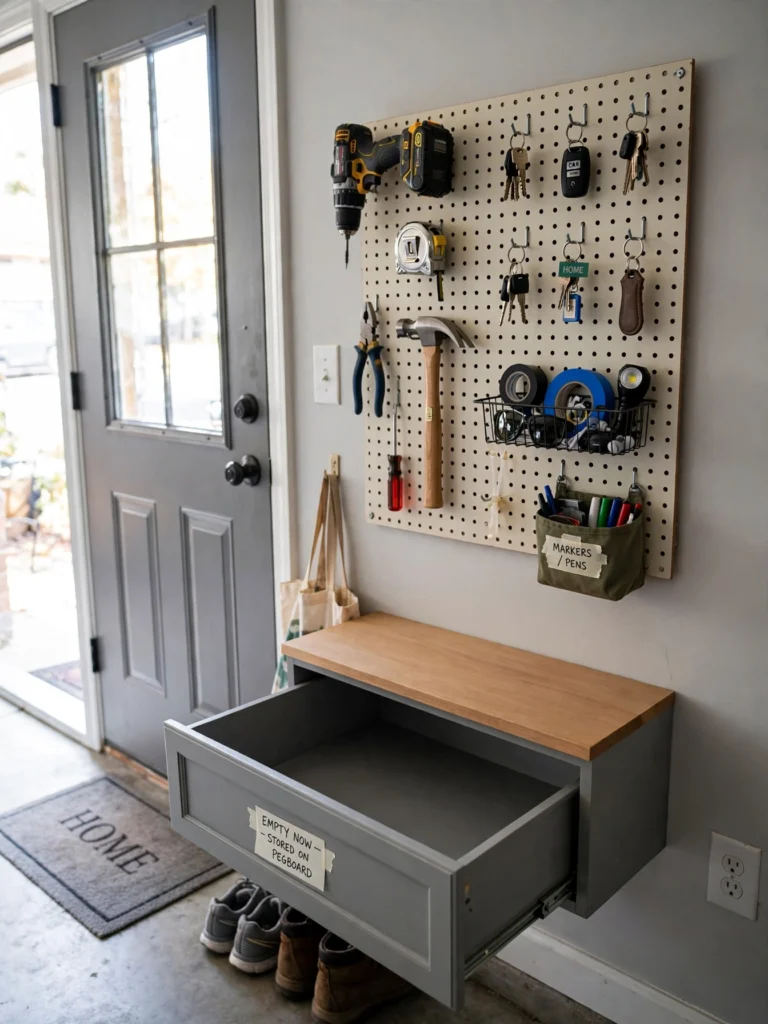
7. Install a Slim Pegboard Section
Even a small three-foot section of pegboard near the entry door can hold your most-used tools, keys, and small items, freeing up a drawer or shelf entirely.
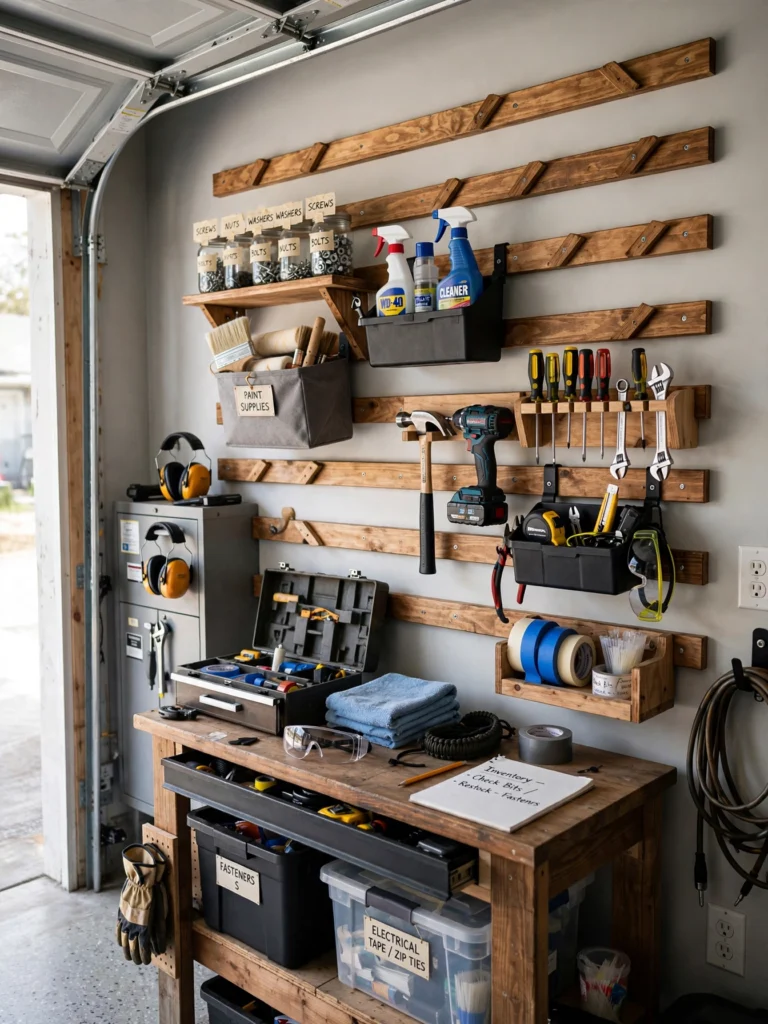
8. Add a French Cleat Wall System
A French cleat setup uses angled wood strips mounted to the wall, letting you hang custom shelves, bins, and tool holders that can be rearranged anytime without new holes or hardware.
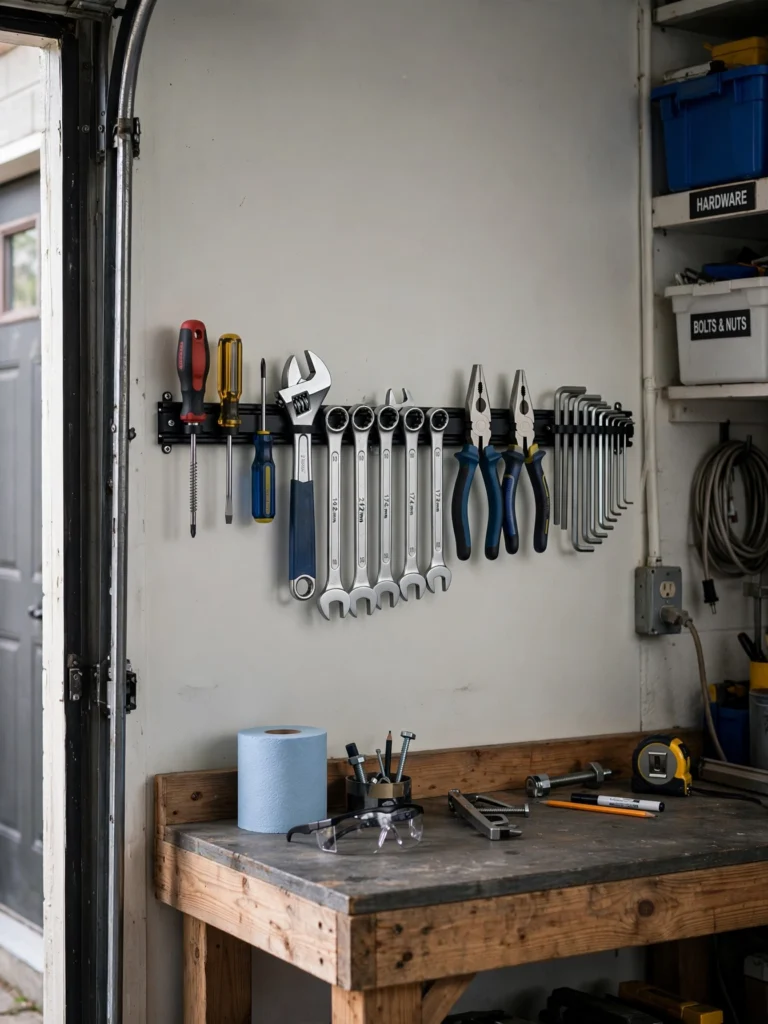
9. Use Magnetic Strips for Metal Tools
A magnetic strip mounted near a workbench or entry point holds screwdrivers, wrenches, and other metal tools upright and visible, without needing a drawer or bin at all.
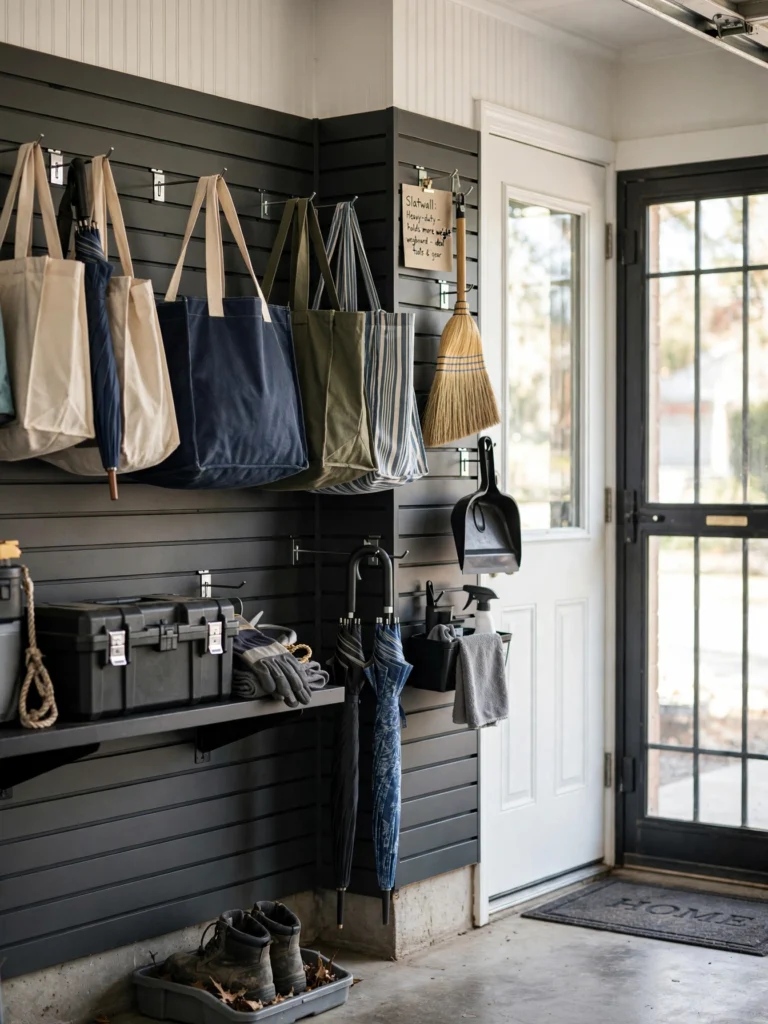
10. Install Slatwall Panels Near the Entry
Slatwall holds more weight than pegboard and works well near the door for frequently grabbed items like reusable bags, umbrellas, or a broom and dustpan.
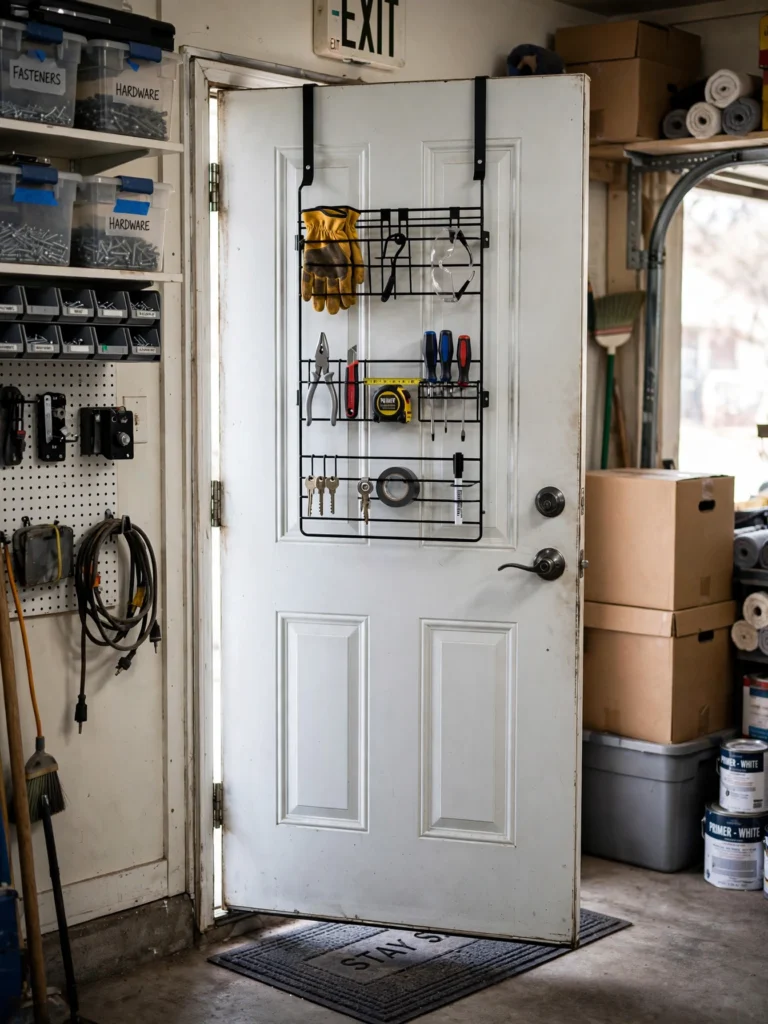
11. Add a Door-Mounted Rack on the Service Door
The back of a garage’s man-door is almost always wasted space. A slim over-the-door rack here can hold gloves, safety glasses, or small hand tools right where you exit.
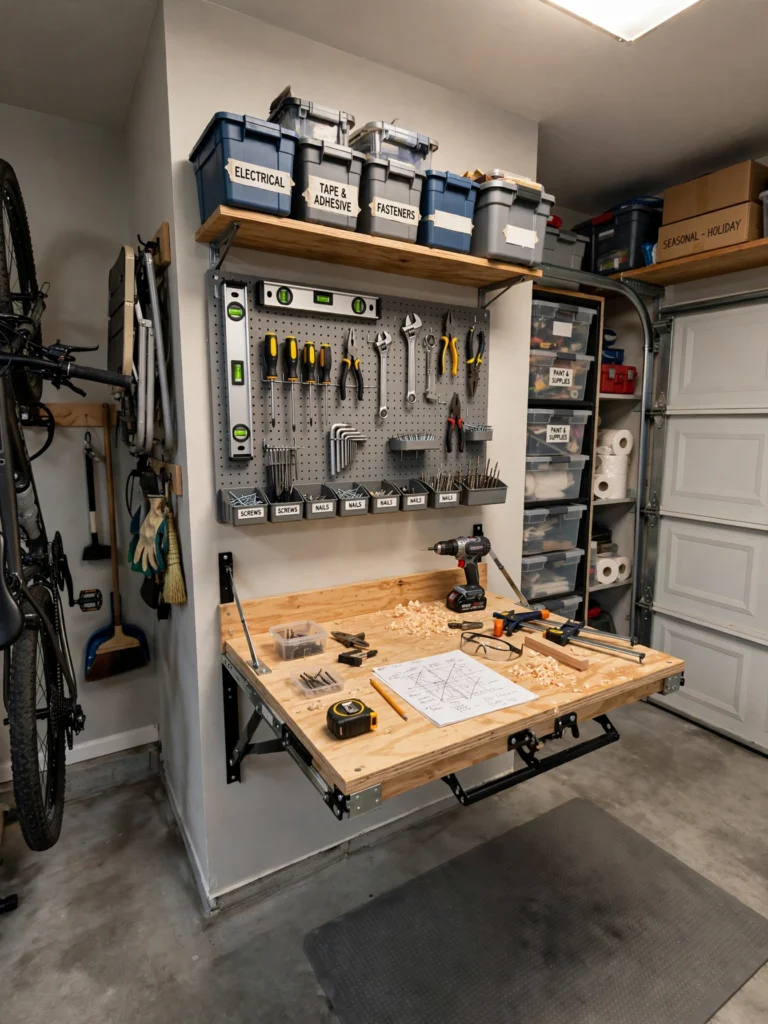
12. Mount a Fold-Down Workbench
If a small garage cannot spare permanent floor space for a workbench, a wall-mounted, fold-down bench provides a work surface when needed and folds flat against the wall the rest of the time.
Underused Space Hacks
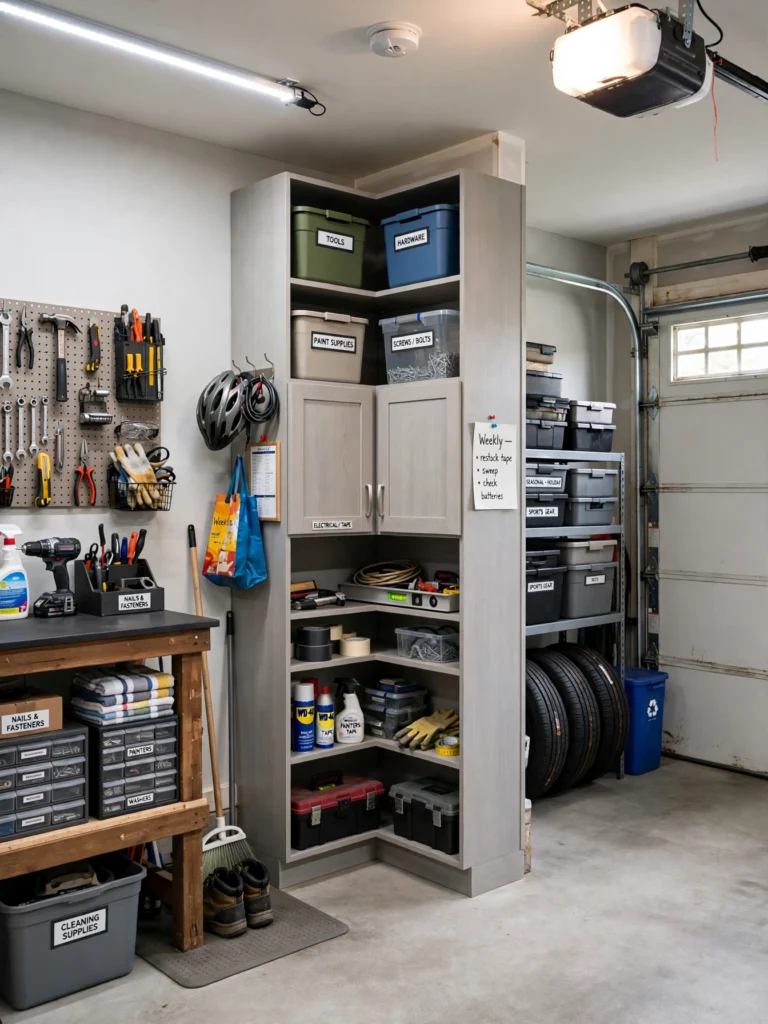
13. Use the Corners
Corners are consistently the most wasted area in a small garage. A corner shelf unit or angled cabinet uses space that would otherwise sit empty between two walls.
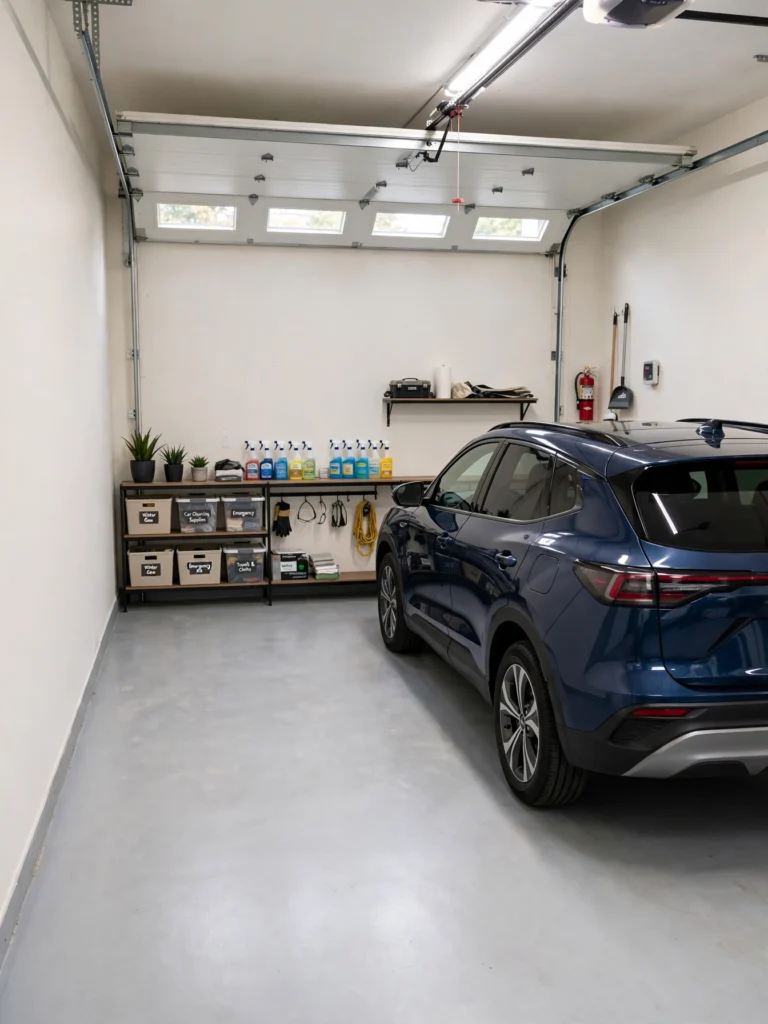
14. Store Items Behind the Car, Not Beside It
If the garage fits one car with room to spare at the front or back, use that end for slim, low-profile shelving rather than piling items along the sides where they narrow the parking lane.
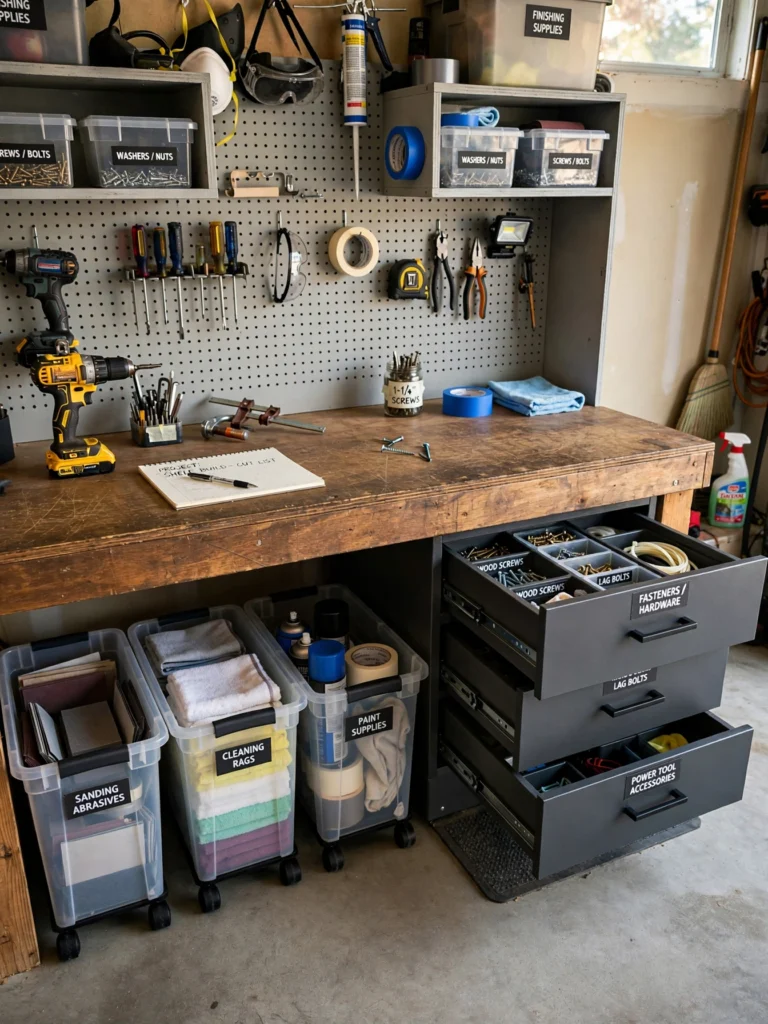
15. Use the Space Under a Workbench
Rather than leaving the area under a workbench open and prone to collecting loose clutter, add rolling bins or a slide-out drawer system to use that space intentionally.
16. Install Narrow Shelving Along the Non-Door Wall
The wall opposite the garage door usually has the least interference from the door’s swing or track. A run of narrow, deep shelving here can hold the bulk of your storage without cutting into the parking lane.
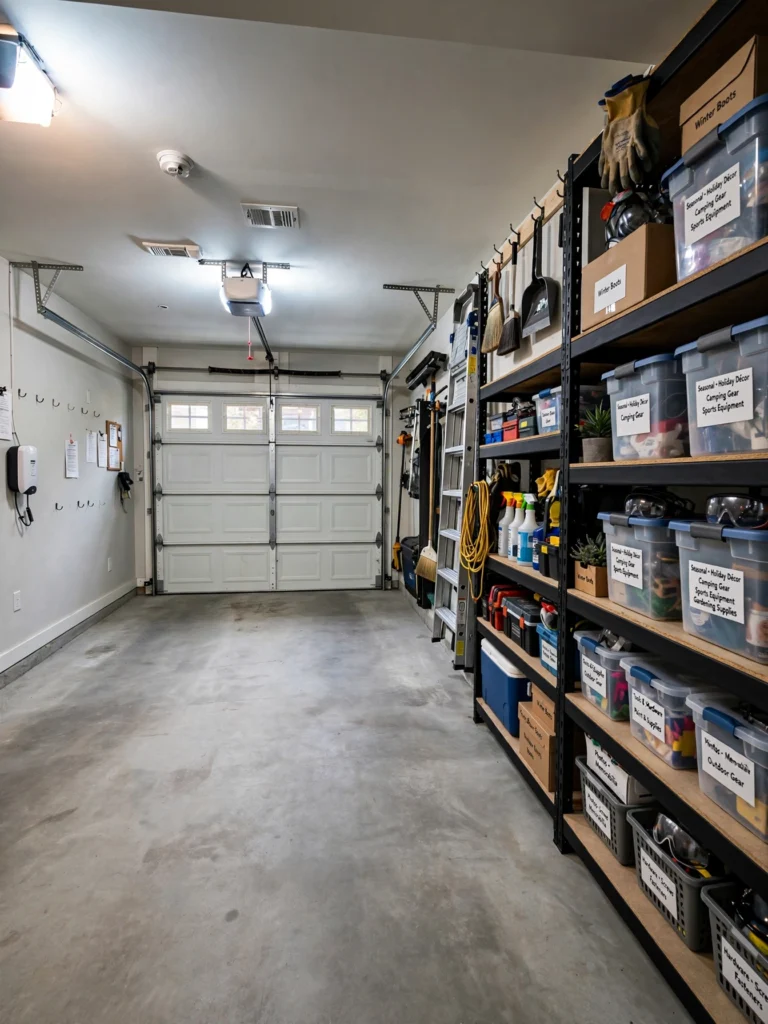
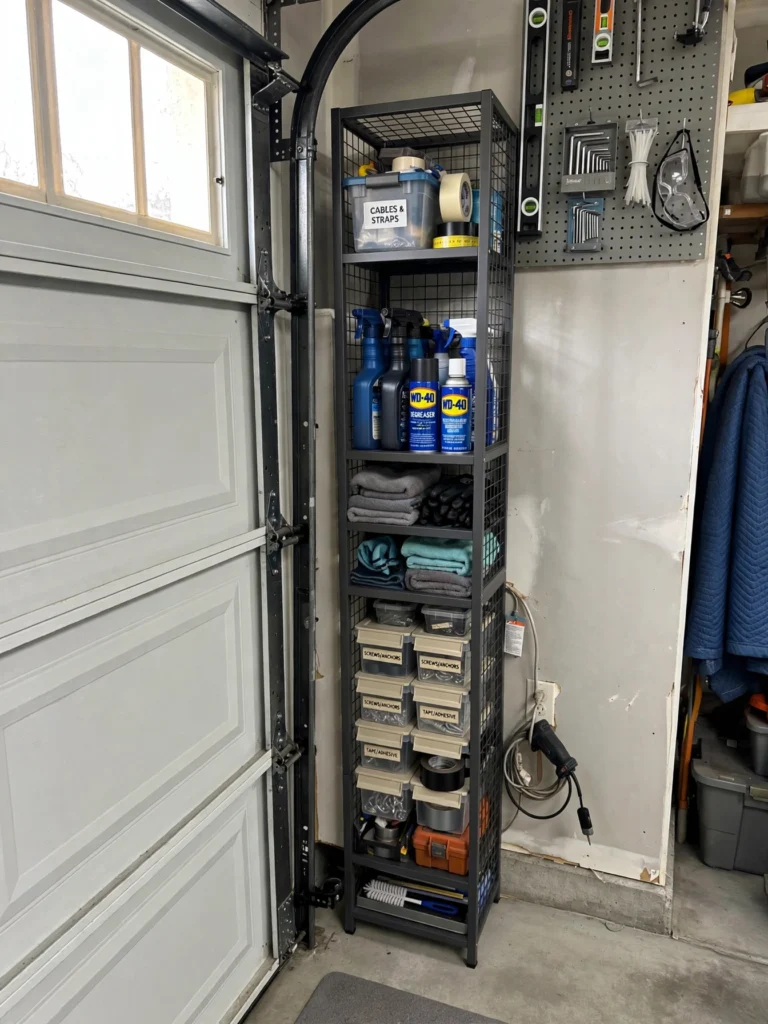
17. Use Ceiling Space Near the Garage Door Track
The area beside (not above) the garage door track, where the door does not travel, is often just wide enough for a slim vertical rack or narrow cabinet.
Furniture and Container Hacks
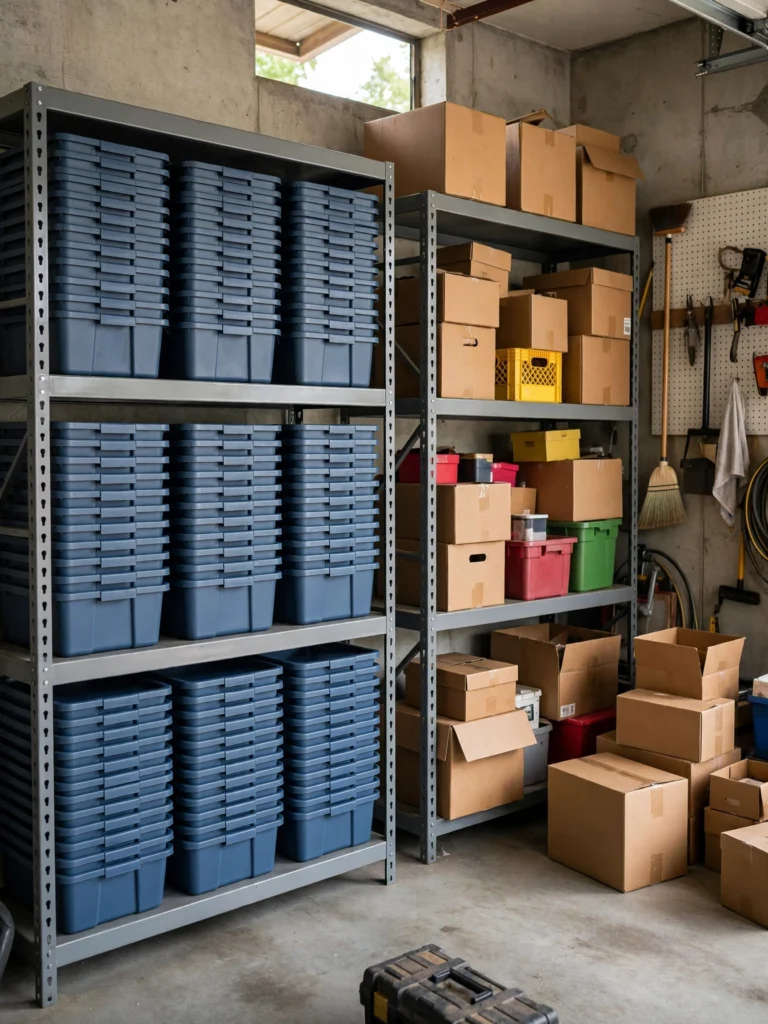
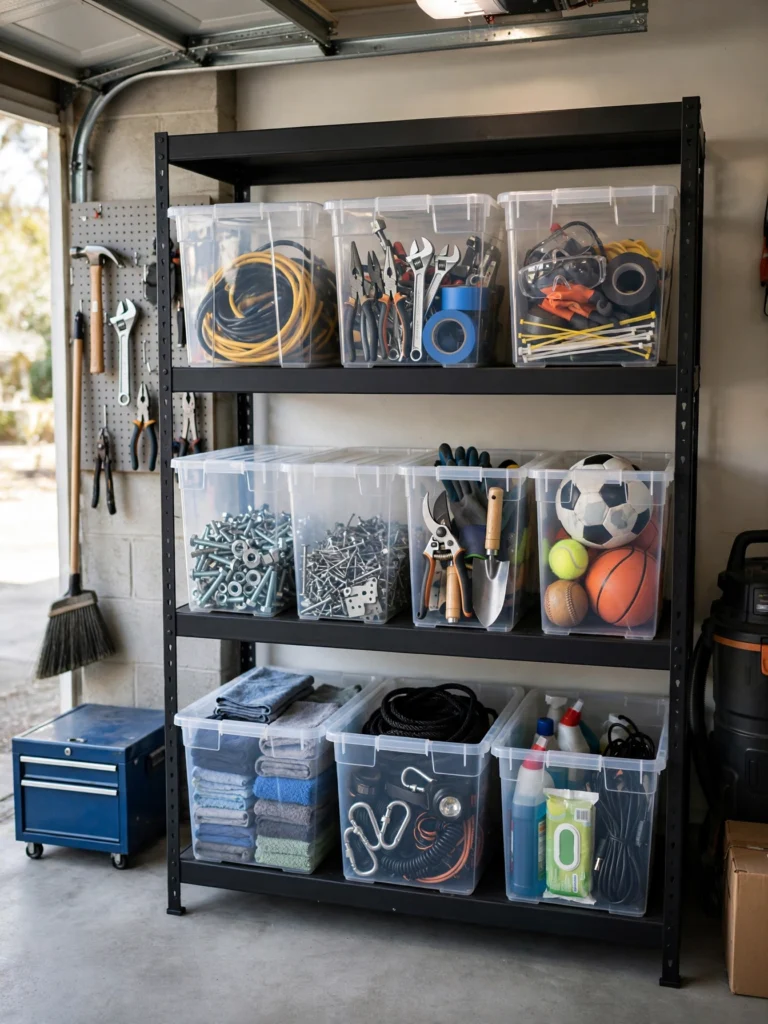
18. Choose Stackable, Uniform Bins
Matching, stackable bins use vertical space far more efficiently than mismatched boxes of different sizes, and they make it easier to shelve items without gaps.
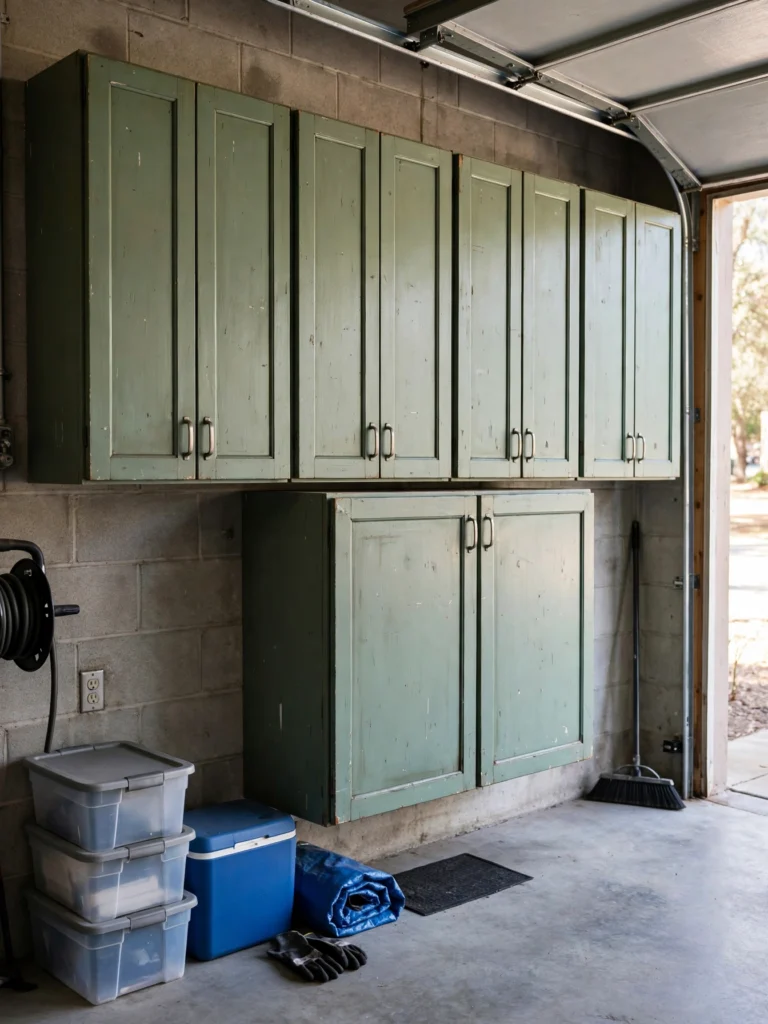
19. Repurpose Old Kitchen Cabinets
Secondhand kitchen cabinets, mounted to the garage wall, provide enclosed, dust-protected storage at a fraction of the cost of new garage-specific cabinetry.
20. Use Clear Containers With Labels
Clear bins let you see contents at a glance without opening every box, which is especially valuable in a small garage where digging through storage to find one item can undo an otherwise organized system.
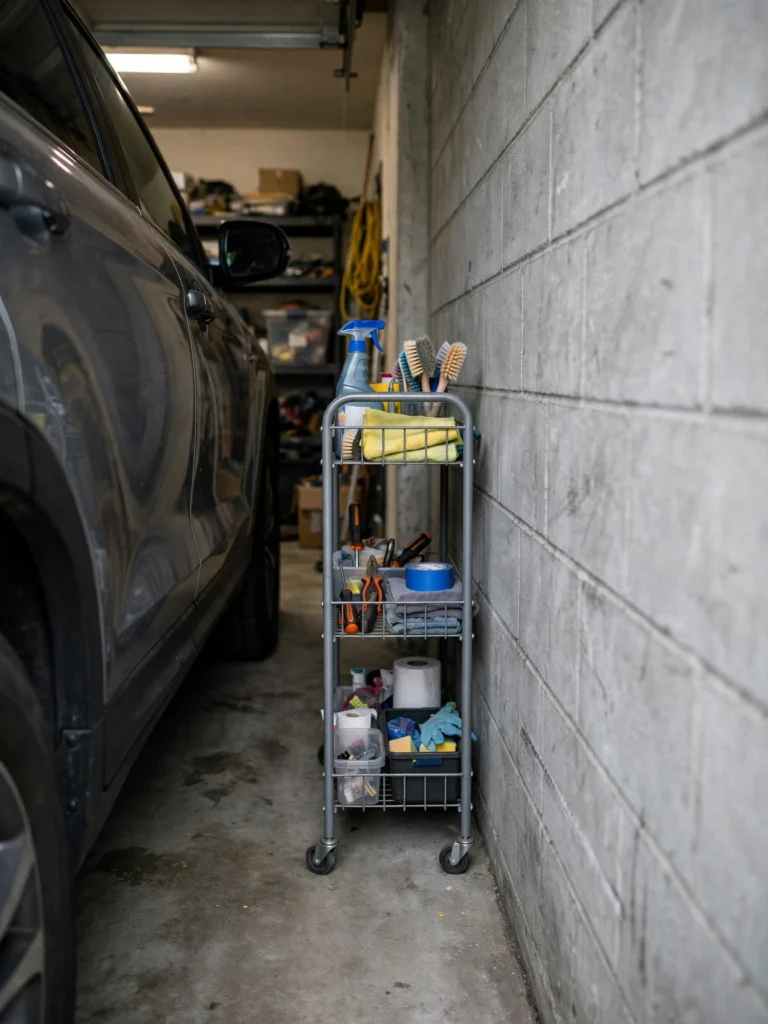
21. Add a Slim Rolling Cart
A narrow rolling cart can slide into the gap between a parked car and the wall, holding cleaning supplies or small tools without needing dedicated floor space of its own.
Zoning and Access Hacks
22. Create a “Daily Use” Zone Near the Door
Keep the items you grab most often a broom, reusable bags, work gloves in the most accessible spot near the entry, and reserve harder-to-reach storage (overhead racks, deep shelving) for seasonal or rarely used items.
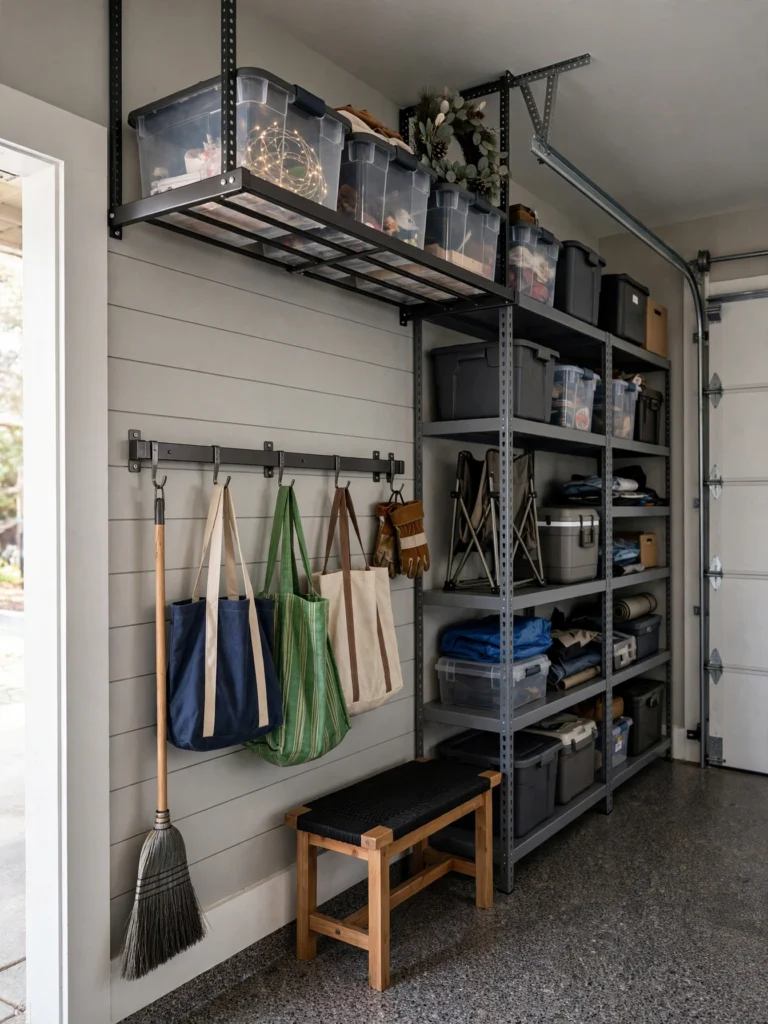
23. Rotate Seasonal Items Twice a Year
Rather than storing holiday decorations, winter gear, and summer equipment all at once, rotate what is accessible based on the season. Keep the off-season items in the least convenient spots (overhead or in the back) and bring the current season’s items forward.
Materials and Tools You’ll Need
Most of these hacks use a small, overlapping set of materials, so it is worth gathering them together before starting rather than making repeated trips to the hardware store.
| Hack Category | Core Materials | Basic Tools |
|---|---|---|
| Overhead storage | Platform brackets or a hoist kit, plywood if building your own | Stud finder, drill, ladder |
| Wall systems | Pegboard, slatwall panels, or French cleat strips | Drill, level, wall anchors |
| Bike and ladder storage | Wall or ceiling hooks rated for the item’s weight | Stud finder, drill |
| Bins and containers | Matching stackable bins, labels | Label maker or marker |
| Fold-down bench | Hinges, a sturdy plywood or hardwood top, wall brackets | Drill, saw (if cutting to size), level |
| Cabinets | Repurposed cabinets or new garage-specific units | Drill, wall anchors, level |
Always confirm what is behind your garage wall (studs, wiring, insulation) before drilling, especially for anything that will hold real weight like an overhead platform or bike hoist.
Maintaining a Small Garage Storage System
Once a small garage is organized, a little ongoing upkeep keeps it from sliding back into clutter.
Reassess every season, not just once a year. Small garages fill up quickly since there is so little slack space to begin with. A quick seasonal check — pulling bins down, wiping shelves, and confirming everything still has a clear “home” — prevents small pileups from becoming a full reorganization project later.
Weigh new purchases against what you will remove. In a small garage, almost nothing new can be added without something else being relocated, donated, or discarded. Treat every new bin or tool as a trade-off rather than an addition.
Keep a small maintenance kit on hand. A few extra wall anchors, hooks, and zip ties make it easy to adjust or add to a wall system as your storage needs shift, without waiting for a full weekend project.
Recheck weight-bearing hardware annually. Overhead platforms, bike hoists, and heavy-duty wall brackets should be inspected at least once a year for any loosening, especially in garages that see temperature swings between seasons.
Revisit your zoning as habits change. If a “daily use” item has moved to storage, or a rarely used item is now needed weekly, adjust its spot rather than working around an outdated system.
Small Garage Storage by Situation
Not every small garage has the same constraints. Here is how to prioritize the hacks above based on your specific setup.
One-Car Garage That Must Fit the Car
Focus first on hacks 1 through 6 (vertical and overhead storage) and hack 14, since keeping the floor completely clear is the top priority. Wall systems should stay slim enough that side mirrors and doors can still open comfortably.
If the garage does not need to fit a vehicle, you have more flexibility to add floor-based shelving and a small workbench. Prioritize hacks 12, 15, and 19 to maximize built storage without needing to protect a parking lane.
Garage Doubling as a Mini Workshop
If you need occasional workbench access in a small footprint, the fold-down bench (hack 12), French cleat system (hack 8), and rolling cart (hack 21) work particularly well together, since all three can be adjusted or moved out of the way when not in use. For a deeper dive into setting up work zones even in compact spaces, see our garage workshop setup ideas guide.
Garage With a Breezeway or Covered Entry
If your garage connects to the home through a breezeway, that covered area can absorb some overflow — bikes, seasonal boots, or a small bench — reducing pressure on the garage itself. Our garage with breezeway guide has more ideas for using that space well.
Budget-Friendly vs. Higher-Investment Small Garage Hacks
| Hack Type | Budget-Friendly Version | Higher-Investment Version |
|---|---|---|
| Overhead Storage | DIY plywood platform | Motorized or pulley-assisted ceiling rack |
| Wall Storage | Basic pegboard | Full French cleat or slatwall system |
| Bike Storage | Simple wall hooks | Ceiling hoist pulley system |
| Cabinets | Repurposed kitchen cabinets | New garage-specific cabinetry |
| Bins | Mismatched bins you already own | Matching, stackable modular bins |
| Workbench | Fold-down wall-mounted bench | Built-in bench with integrated storage |
Most small garages benefit from starting with the budget-friendly column and upgrading specific hacks over time as priorities become clear.
Common Small Garage Storage Mistakes to Avoid
1. Buying storage before measuring the space A shelf or cabinet that looks compact in a store can still block a car door or narrow a walking path. Measure clearances before purchasing anything.
2. Storing rarely used items in the most convenient spots Prime, easy-to-reach storage should go to daily-use items, not holiday decorations that only come out once a year.
3. Ignoring the ceiling entirely The ceiling is one of the largest unused surfaces in most small garages. Skipping overhead storage means giving up a significant amount of potential space.
4. Mixing storage categories randomly Bins that combine unrelated items (tools mixed with holiday decorations, for example) make it harder to find anything quickly, which defeats the purpose of organizing in the first place.
5. Forgetting to leave clearance for car doors and mirrors Wall-mounted systems installed too close to the parking lane can make it difficult to open doors fully or fold in mirrors. Leave a few extra inches of buffer wherever the car will be parked.
6. Not accounting for weight limits Overhead racks and wall systems have weight limits. Overloading them, especially above a parking spot, is a safety risk as much as an organizational one.
Quick 23-Point Small Garage Storage Checklist
| # | Hack |
|---|---|
| 1 | Ceiling-mounted storage platform |
| 2 | Bike pulley or hoist system |
| 3 | Shelf above the garage door |
| 4 | Rafter storage |
| 5 | Wall-mounted ladder rack |
| 6 | Vertical lumber/long-item rack |
| 7 | Slim pegboard section |
| 8 | French cleat wall system |
| 9 | Magnetic tool strip |
| 10 | Slatwall near the entry |
| 11 | Door-mounted rack on the service door |
| 12 | Fold-down wall-mounted workbench |
| 13 | Corner shelving |
| 14 | Storage behind, not beside, the car |
| 15 | Storage under the workbench |
| 16 | Narrow shelving on the non-door wall |
| 17 | Slim rack beside the door track |
| 18 | Stackable, uniform bins |
| 19 | Repurposed kitchen cabinets |
| 20 | Clear, labeled containers |
| 21 | Slim rolling cart |
| 22 | Defined daily-use zone near the door |
| 23 | Seasonal rotation twice a year |
Small Garage Storage Hacks for Renters
If you rent your home, permanent solutions like drilled-in cleats or ceiling hoists may not be an option. These non-permanent alternatives deliver similar benefits without modifying the structure:
- Use freestanding, adjustable shelving units instead of wall-mounted shelving
- Choose a rolling tool cart or cabinet instead of a built-in workbench
- Look for tension-mounted rods or freestanding racks for bikes and ladders instead of ceiling hooks
- Use removable, adhesive-backed hooks rated for garage use for lightweight items only
- Stick to stackable bins and portable shelving that can move with you rather than anything drilled into studs
- Photograph the garage’s original condition before making any changes, and keep hardware from removed fixtures (like factory shelving brackets) in a labeled bag for move-out
Always check your lease for any restrictions on garage modifications before drilling into walls, ceilings, or rafters, even for small anchors.
A Sample Small Garage Transformation
To see how these hacks work together, here is a simple before-and-after scenario for a typical one-car garage that could not fit a car due to clutter.
Before: Bikes leaned against the back wall, holiday decoration boxes stacked along one side, a folding table used as an improvised workbench, and loose tools scattered across a shelf near the door. The car had not parked inside in over a year.
After, using hacks from this list:
- A bike pulley system (hack 2) lifted two bikes to the ceiling, clearing the entire back wall
- A ceiling-mounted platform (hack 1) took over holiday decoration storage, freeing the side wall completely
- The folding table was replaced with a wall-mounted, fold-down workbench (hack 12) that stays flat against the wall except when needed
- A small pegboard section (hack 7) near the door corralled loose tools that had been sitting on an open shelf
- Stackable, labeled bins (hack 18) replaced a pile of mismatched cardboard boxes along the non-door wall (hack 16)
The result was a clear parking lane down the middle of the garage, a fold-down workbench available for occasional projects, and every item — from bikes to bins — given a defined “home” for the first time. None of the individual changes required a large budget; the transformation came from combining several small, targeted hacks rather than one large purchase.
This kind of layered approach is usually more effective than buying one large storage system and hoping it solves every problem at once. Start with whichever single change would free up the most floor space in your own garage, then add the next hack once that first change feels settled into your routine.
Small Garage vs. Large Garage: What Actually Changes
It helps to understand why small garages need a distinct approach rather than simply a scaled-down version of a full workshop setup.
| Factor | Small Garage | Large Garage |
|---|---|---|
| Floor space priority | Must stay almost entirely clear | Can support fixed furniture and stations |
| Storage direction | Vertical and overhead first | Wall, floor, and overhead all viable |
| Workbench approach | Fold-down or mobile | Permanent, dedicated bench |
| Zoning | Minimal, often just “daily use” vs. “storage” | Multiple distinct zones by activity |
| Flexibility needed | High — most items must be movable or foldable | Lower — more items can stay in fixed positions |
Recognizing which category your garage falls into helps you avoid copying a large-workshop layout that will not actually fit a smaller footprint.
Frequently Asked Questions
What is the single best storage hack for a small garage? Overhead storage tends to have the biggest impact, since ceiling space is almost always completely unused in a small garage and can absorb an entire category of seasonal items.
How do I organize a small garage without giving up parking space? Focus on vertical and overhead systems rather than floor-based shelving, and keep a clear buffer zone along both sides of where the car parks.
Are pegboards or slatwall better for a small garage? Pegboard is more affordable and works well for lighter tools, while slatwall holds more weight and is better suited to heavier items or high-traffic entry points. Many small garages use a small section of each.
How often should I rotate seasonal storage? Twice a year works well for most households: once heading into warmer months and once heading into colder ones — so the most relevant gear is always in the most accessible spot.
Can I add garage storage systems myself, or do I need a professional? Most of the hacks on this list, including pegboard, shelving, and bins, are simple DIY installs. Heavier systems like ceiling hoists or built-in cabinetry may benefit from professional installation, especially if they involve mounting into rafters or trusses.
Does adding smart storage or lighting help in a small garage? Yes smart plugs and lighting can make it easier to see and access overhead or hard-to-reach storage without fumbling for a switch. Our smart home guide covers more ways to bring automation into a garage setup.
How do I store items in a small garage without drilling into the walls? Freestanding shelving, rolling carts, and tension-mounted racks all provide similar organizational benefits to wall-mounted systems without requiring permanent modifications, which makes them a good fit for renters.
What is the biggest space-waster in most small garages? Floor-level boxes and loose piles are usually the biggest culprit, since they consume prime, easily accessible space that could otherwise fit a car or a walking path. Moving those items to overhead or wall storage typically frees up the most usable floor space of any single change.
Final Thoughts
A small garage does not have to mean a cramped, cluttered one. Nearly every hack on this list is built around the same idea: use the space that is already there but rarely used the ceiling, the corners, the backs of doors before assuming you need to remove items or find storage elsewhere. Start with one or two hacks that solve your biggest daily frustration, whether that is fitting the car back inside or finally finding a spot for the bikes, and build outward from there.
For a full room-by-room organizing approach, revisit our garage organization ideas guide, and if you are also setting up a workspace in the same footprint, our garage workshop setup ideas guide pairs well with the hacks above.