
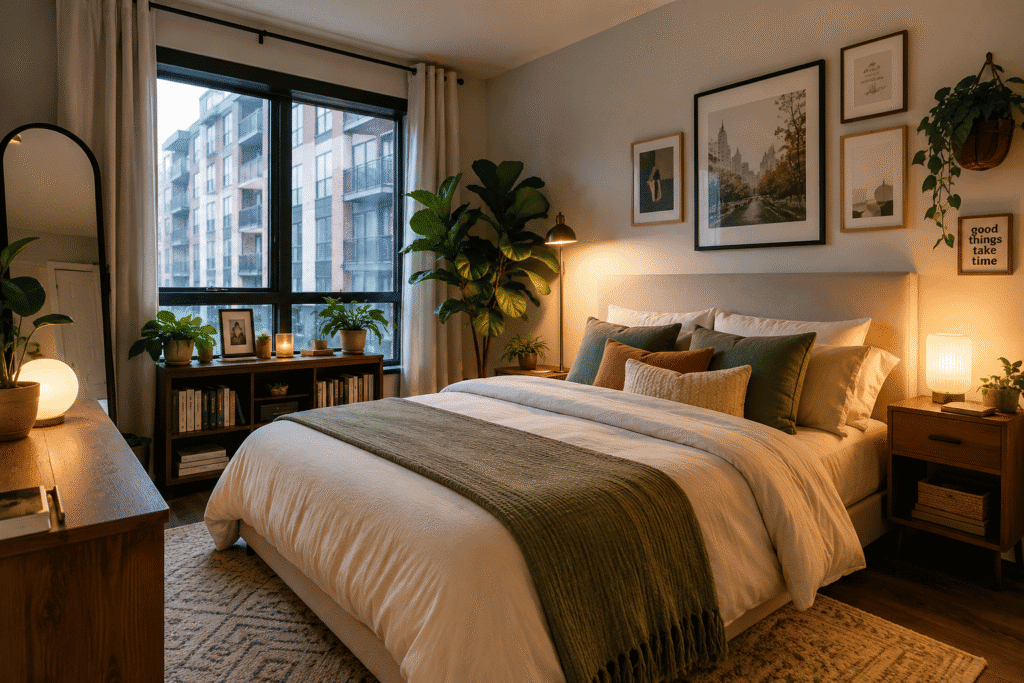
There’s a specific kind of magic in walking into a small apartment that feels intentional – where every piece earns its spot and the whole space feels bigger than its square footage. That’s the goal of good apartment bedroom decor: not more stuff, just smarter choices.
Whether you’re working with a true one room apartment, a proper 1 bedroom apartment, or a bedroom apartment ideas board full of looks you’re dying to try, this guide breaks down exactly how to decorate on a real budget – no renovation, no landlord drama, no wasted money on things that don’t actually make the space feel better.
Apartment Decorating on a Budget: Where to Actually Spend Your Money
Contents
- 1 Apartment Decorating on a Budget: Where to Actually Spend Your Money
- 2 One Bedroom Apartment Ideas: Making the Layout Work For You
- 3 One Room Apartment: Zoning a Studio Without Walls
- 4 Bedroom Apartment Ideas: Small Bedroom, Big Style
- 5 One Bedroom Apartment Ideas Living Room: Making a Multi-Purpose Space Feel Intentional
- 6 Studio and Small Apartment Storage: The Multi-Functional Furniture Rule
- 7 Renter-Friendly Rules for Every Apartment Bedroom Decor Project
- 8 Final Thoughts
Before you buy anything, it helps to know which upgrades give you the most visual impact per dollar. When it comes to apartment decorating on a budget, these are the categories worth prioritizing first:
- Lighting – swap harsh overhead bulbs for a mix of floor lamps, table lamps, and warm-toned bulbs. Layered lighting changes the entire mood of a room for very little money.
- Textiles – throw pillows, a soft throw blanket, and a large area rug add color and warmth instantly and can move with you when you leave.
- A statement mirror – an oversized or uniquely shaped mirror visually doubles a room and reflects more light, which matters most in smaller spaces.
- Removable wallpaper – a peel-and-stick accent wall behind the bed or on one wall of the living area gives you a designer-level focal point without touching your security deposit.
- Art, framed with intention – thrifted frames plus affordable prints (digital downloads you print yourself are the cheapest option) instantly make a rental feel finished.
A good rule of thumb: spend on the things that touch light, color, and texture first. Furniture upgrades can come later – the room will already feel 80% more “done” with just these five categories handled.
One Bedroom Apartment Ideas: Making the Layout Work For You
Good one bedroom apartment ideas start with the floor plan, not the decor. Before you buy a single throw pillow, walk through your space and answer these questions:
- Where does the light come from? Your main seating or desk area should generally sit near natural light, while your bed can be tucked into a slightly darker corner for better sleep.
- What’s your one clear walking path? Every good layout has an obvious, unobstructed route from the entry to the kitchen, bathroom, and bed. If you have to squeeze past furniture daily, it’s the wrong layout.
- Which room needs to feel bigger – the bedroom or the living room? In a proper 1 bedroom apartment decor plan, most people underestimate how much a bedroom can shrink once it’s just for sleeping, freeing up real square footage for the living space.
Once you know your traffic flow and light sources, place your biggest furniture piece (the bed, or the sofa in an open layout) first, then build everything else around it. This single change – furniture-first rather than decor-first – is the difference between a room that flows and one that always feels slightly cramped.
One Room Apartment: Zoning a Studio Without Walls
If you’re working with a true one room apartment (a studio, where the bedroom and living room share the same footprint), the challenge isn’t square footage – it’s definition. A studio without clear zones just reads as one big undefined room, no matter how nice the furniture is.
Here’s how to create separation without construction:
- Anchor with a rug. Placing a large area rug under your seating area – and a separate, smaller rug near the bed – visually splits the space into “living” and “sleeping” zones instantly.
- Use furniture as a divider. The back of a sofa, a tall open bookshelf, or a slim console table can act as a soft wall between zones. Position your bed against the far wall or in a corner away from the entry so the room doesn’t read as a bedroom the second someone walks in.
- Try a curtain or folding screen. A ceiling-mounted curtain track or a freestanding folding screen gives you an actual visual break – and privacy – for a fraction of the cost of a room divider wall.
- Repeat one color story on both “sides.” Even with zones defined, keeping a consistent palette across the sleeping and living areas keeps the whole one room apartment feeling like one cohesive home instead of two mismatched spaces.
Bedroom Apartment Ideas: Small Bedroom, Big Style
When your bedroom apartment ideas need to work overtime in a small footprint, these swaps make the biggest difference without needing more square footage:
- Storage bed or bed risers – a bed frame with built-in drawers (or risers added to your existing frame) gives you hidden storage for linens, off-season clothes, or shoes without adding a single extra piece of furniture.
- Floating nightstands or wall-mounted shelves – freeing up floor space around the bed makes even a tiny bedroom feel more open.
- A large mirror leaned against the wall – beyond the styling benefit, it bounces light around a room that likely only has one window.
- Soft, layered bedding – a duvet, a textured throw, and two or three pillows in coordinating tones do more for “finished bedroom” than almost any decor purchase you could make.
- Command strip picture ledges – a small gallery moment above the headboard adds personality without a single hole in the wall.
One Bedroom Apartment Ideas Living Room: Making a Multi-Purpose Space Feel Intentional
In most one bedroom apartment ideas living room searches, the real question isn’t “what furniture should I buy” – it’s “how do I make one room do the job of three” (living room, home office, and sometimes dining room). A few approaches that consistently work:
- Let the sofa define the room. Position it to face the room’s natural focal point (a window, a TV, or even just the open floor plan) rather than pushing it against a wall by default.
- Add a home office corner, not a home office room. A slim desk angled toward a window, paired with a low bookshelf behind it, creates a visual boundary between “work” and “relax” without needing a dedicated room.
- Use a storage ottoman as your coffee table. It gives you a surface for drinks and remotes, hidden storage for blankets or games, and doubles as extra seating when guests come over.
- Keep a single, cohesive rug under the main seating area to visually ground the living room portion of an open floor plan, especially if it’s combined with a dining nook or entry.
- Choose furniture that’s proportional to the room, not the smallest pieces you can find. A too-small sofa in an otherwise open living room can actually make the space feel more awkward and undefined than a properly-scaled piece would.
Studio and Small Apartment Storage: The Multi-Functional Furniture Rule
No matter which layout you’re working with, the single best space-saving principle is this: if a piece of furniture only does one job, it needs to be small, narrow, or essential. Everything else should multi-task. A few favorites:
- Sofa bed or daybed for lounging by day, sleeping by night (ideal for a one room apartment with guests)
- Storage ottomans that double as a coffee table, footrest, or extra seating
- Nesting tables that expand for guests and tuck away when not in use
- Lift-top coffee tables that convert from a laptop workstation to a place to hide clutter in seconds
- Vertical storage – tall bookcases, floating shelves, and over-the-door organizers use height instead of floor space, which matters most in a small 1 bedroom apartment decor plan where every square foot is doing double duty
Renter-Friendly Rules for Every Apartment Bedroom Decor Project
Whatever style you land on, keep these renter-safe habits in mind so your deposit stays intact:
- Use removable wallpaper and decals instead of paint for accent walls
- Hang art and shelves with picture-hanging strips, not nails, whenever possible
- Choose plug-in or battery-operated lighting over anything that requires rewiring
- Favor freestanding furniture (bookshelves, garment racks, folding screens) over anything built-in
- Always check your lease before making even “renter-friendly” changes – some buildings have stricter rules than others
Final Thoughts
The best apartment bedroom decor doesn’t come from a bigger budget – it comes from smarter choices: layered lighting, multi-functional furniture, a clear layout, and a handful of pieces that actually reflect your style. Whether you’re decorating a full 1 bedroom apartment or figuring out how to zone a single studio room, start with the fundamentals above and let the rest of the decor build from there.
Save this post for your next apartment refresh, and pin your favorite section so you can come back to it room by room.