
Introduction:
Contents
- 1 Introduction:
- 1.1 1. Minimalist Metal Fence with Horizontal Slats
- 1.2 2. Wooden Fence with Vertical Panels
- 1.3 3. Wrought Iron Gate with Decorative Details
- 1.4 4. Sliding Gate with Automatic Access
- 1.5 5. Contemporary Aluminum Fence with Clean Lines
- 1.6 6. Steel Gate with Smart Lock System
- 1.7 7. Privacy Fence with Decorative Panels
- 1.8 8. Modern Wooden Gate with Horizontal Slats
- 2 How to Choose the Right Fence and Gate Style for Your Home
- 2.1 1. What’s your priority – privacy, security, or curb appeal?
- 2.2 2. How much maintenance are you willing to take on?
- 2.3 3. Do you need automated access?
- 2.4 9. Automatic Swing Gate for Driveways
- 2.5 10. Mixed Material Fence with Metal and Wood
- 2.6 11. Vertical Slat Gate with Sleek Finish
- 2.7 12. Decorative Iron Fence for Garden Area
- 2.8 13. Automatic Gate with Sensor Technology
- 2.9 14. Aluminum Fence with Powder-Coated Finish
- 2.10 15. Custom Modern Gate with Decorative Texture
- 3 Fence and Gate Cost Breakdown
- 4 Fence Materials Compared: Wood vs. Metal vs. Aluminum
- 5 Frequently Asked Questions
- 6 Final Thoughts:
Your fence and gate do more talking than almost any other part of your home’s exterior – before a guest ever reaches your front door, the entrance has already set the tone for style, security, and how well-kept the whole property feels. They are the first thing people notice when they come to your house. Modern designs give a smart and clean look to the entrance. Here are some of the best ideas for fences and gates for your home.
1. Minimalist Metal Fence with Horizontal Slats
Horizontal slat fencing has become one of the most requested modern exterior upgrades, largely because the clean, repeating lines read as contemporary without looking cold or industrial. Unlike traditional picket fencing, horizontal slats create a lower, more open sightline that still blocks direct views into the yard — giving you privacy without feeling boxed in. Aluminum and powder-coated steel are the two most common materials for this style, both chosen for their resistance to warping, rust, and rot compared to wood. Because the slats are evenly spaced rather than solid, this design also handles wind load better than a solid privacy fence, making it a smart choice for exposed or coastal properties. It pairs especially well with modern, mid-century, or minimalist home exteriors where straight lines and a low-maintenance finish matter more than ornamentation.
🚪 Want to make a grand first impression with your home entrance? Explore these stunning double door design ideas that instantly boost your curb appeal:
➤ 20 Grand Entry Concepts Featuring Sculpted Double Doors
2. Wooden Fence with Vertical Panels
A vertical panel wood fence brings warmth and natural texture that metal and composite materials struggle to replicate, which is why it remains one of the most popular styles for homes leaning into a farmhouse, cottage, or garden-forward aesthetic. It pairs especially well with garden beds, landscaped walkways, and homes that already feature natural wood accents – including a Craftsman Barn Door at the entry. The vertical orientation of the panels does more than look elegant — it visually elongates the fence line, making a yard feel taller and more established even at a standard 6-foot height. Cedar and pressure-treated pine are the most common wood choices, offering a balance between cost and rot resistance, though cedar requires less frequent sealing over time. This style also offers full privacy, since the panels sit flush against one another rather than leaving gaps like a horizontal slat design.

3. Wrought Iron Gate with Decorative Details
Wrought iron gates carry a sense of permanence and craftsmanship that few other materials can match, which is why they remain a top choice for both traditional estate-style homes and modern properties looking for a striking contrast against clean architecture. The decorative scrollwork, finials, and custom patterns aren’t just aesthetic flourishes — they also allow airflow and visibility through the gate while still creating a strong physical barrier, which many homeowners prefer over a fully solid gate for security sightlines. Because wrought iron is exceptionally durable, a well-maintained gate can easily last 20+ years with only occasional repainting or rust treatment. These gates are also highly customizable, meaning you can commission a design that echoes existing ironwork elsewhere on the property, like railings or window grilles, for a cohesive exterior look.

4. Sliding Gate with Automatic Access
An automatic sliding gate solves one of the biggest practical headaches of a swing gate: needing clear space in front of the entrance for the gate to open into. Because sliding gates travel parallel to the fence line instead of swinging outward, they’re ideal for driveways on a slope, near a street, or with limited approach space. Most systems pair the gate with a keypad, remote, or smartphone-based control, and many newer models integrate with smart home systems for schedule-based access or guest codes. While the upfront cost is higher than a manual gate due to the motor, track, and control hardware, the combination of convenience and enhanced security — especially for homes with long driveways — makes it a popular upgrade for growing families and anyone who values not having to get out of the car to open a gate.

5. Contemporary Aluminum Fence with Clean Lines
Aluminum fencing has become the go-to material for homeowners who want a modern look without a demanding maintenance schedule. Unlike steel or wrought iron, aluminum won’t rust, which means no repainting or rust-treatment cycle over the life of the fence — a major selling point for anyone who’s dealt with a corroding iron fence in a humid or coastal climate. Its lightweight nature also makes it easier and less expensive to install than heavier metal alternatives, without sacrificing structural strength for a standard residential application. Most aluminum fencing comes pre-finished in a powder coat, available in matte black, bronze, and white finishes that suit both garden borders and full-property perimeter fencing. It’s a particularly strong fit for pool areas and modern landscaping, where clean lines and low upkeep matter more than the ornate detail of wrought iron.

6. Steel Gate with Smart Lock System
Pairing a steel gate with a smart lock system combines two of the most important qualities in an entrance: physical strength and controllable access. Steel itself offers a higher strength-to-weight ratio than aluminum or wood, making it a strong choice for main entrances or gates that need to resist forced entry. The smart lock layer adds a level of convenience that traditional key-and-latch systems can’t match — options range from keypad codes and key fob access to full smartphone app control, some of which let you issue temporary codes for guests, contractors, or delivery access. For homeowners already using a broader smart home ecosystem, many smart gate locks integrate directly with existing security cameras and video doorbells, giving a single unified view of who’s coming and going.

7. Privacy Fence with Decorative Panels
Decorative privacy fencing takes the basic function of a solid privacy fence — blocking sightlines from the street or neighboring yard — and adds visual interest through cut-out patterns, varied panel widths, or alternating textures. Rather than one flat, uniform wall of wood or vinyl, these designs break up the surface with geometric shapes, natural motifs, or spaced slats that let in filtered light and a bit of airflow while still shielding the yard from view. This makes them particularly popular for backyard patios, pool enclosures, and garden spaces where full privacy is the priority, but a plain solid fence would feel visually heavy. Decorative panels can be mixed into an otherwise standard fence line as accent sections, which is a cost-effective way to add style without redesigning the entire perimeter.

8. Modern Wooden Gate with Horizontal Slats
A horizontal slat wooden gate brings the same clean, linear look popularized by modern horizontal fencing to the entry point itself, creating visual consistency across the whole property line. The warm tone of the wood softens what could otherwise feel like a purely industrial design, making it a versatile choice for both small city lots and larger suburban homes. Because the slats are typically spaced with small gaps, the gate allows some visibility and airflow through the entrance without fully exposing the yard behind it. This style is also relatively easy to customize — the slat width, spacing, and wood tone can all be adjusted to match an existing fence or exterior color scheme, making it one of the more flexible gate styles for a coordinated look.

How to Choose the Right Fence and Gate Style for Your Home
With so many material and mechanism options, narrowing things down usually comes down to three practical questions:
1. What’s your priority – privacy, security, or curb appeal?
If privacy is the main goal, look at solid wood panels or decorative privacy fencing. If security is the top concern, wrought iron or steel with a smart lock system offers the strongest deterrent. If curb appeal matters most and privacy isn’t a major need, aluminum or wrought iron with decorative detailing makes the strongest visual statement.
2. How much maintenance are you willing to take on?
Wood requires the most upkeep — periodic staining or sealing to prevent rot and warping. Aluminum and powder-coated steel need almost none, since they resist rust and don’t require refinishing. Wrought iron falls in the middle, needing occasional rust treatment and repainting over its lifespan.
3. Do you need automated access?
Long driveways, rental properties, or homes with frequent deliveries benefit most from an automatic sliding or swing gate. If the entrance is used infrequently or by residents only, a manual gate with a quality latch is often the more cost-effective choice.
A quick rule of thumb: for the best balance of low maintenance and modern style, aluminum fencing with a horizontal slat gate is hard to beat. For homes prioritizing a traditional, high-security look, wrought iron remains the gold standard.
9. Automatic Swing Gate for Driveways
A swing gate remains one of the most classic and recognizable driveway entrances, and modern automation has removed its biggest inconvenience — needing to manually open and close it. Motorized swing gates typically use an arm or underground actuator to push the gate open and closed, controlled via remote, keypad, or app. Because the gate swings into or away from the driveway, it does require clear space on at least one side, which makes it best suited to properties with a wider entrance or setback from the street. Swing gates also tend to pair especially well with wrought iron or ornate wood designs, since the full gate face is visible when closed, making it a strong focal point for the property’s overall curb appeal.

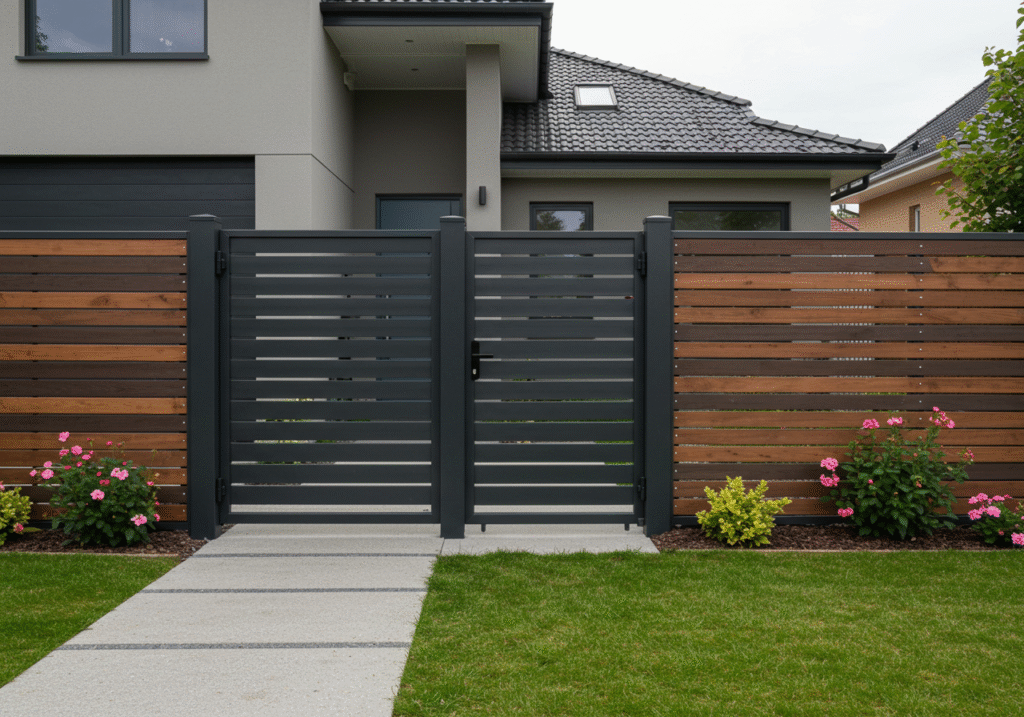
10. Mixed Material Fence with Metal and Wood
Combining metal and wood in a single fence design lets you draw on the strengths of each material rather than compromising with just one. Metal framing — typically steel or aluminum posts and horizontal rails — provides structural rigidity and long-term durability, while wood infill panels add the warmth and natural texture that pure metal fencing lacks. This approach is increasingly popular in modern and transitional-style homes, where a fully metal fence can feel too stark and a fully wood fence can feel too traditional. Mixed material fences are also easier to repair section-by-section over time, since a damaged wood panel can be replaced without affecting the surrounding metal frame — a practical advantage over a fence built entirely from one continuous material.

11. Vertical Slat Gate with Sleek Finish
A vertical slat gate creates a striking, linear look that works particularly well as a focal point at the main entrance, especially when paired with a matching vertical slat fence for a cohesive design. The vertical orientation tends to read as slightly more formal and architectural than horizontal slats, making it a popular choice for modern and contemporary home exteriors. This design is versatile across materials — steel and aluminum options offer a sleek, low-maintenance finish, while a wood version brings more warmth for a transitional look. Because the slats run top to bottom, this style also tends to disguise ground-level unevenness better than horizontal designs, which can be useful on sloped driveways or uneven entrances.

12. Decorative Iron Fence for Garden Area
A decorative iron fence is one of the most effective ways to define a garden space without blocking the view of the plantings inside it — unlike a solid privacy fence, the open iron pattern lets the garden remain visible while still marking a clear boundary. Patterns can range from simple straight pickets to elaborate scrollwork, spirals, or botanical-inspired motifs that echo the garden’s own aesthetic. Because iron fencing for garden borders is typically shorter than a full privacy fence — often 3 to 4 feet — it’s also less expensive per linear foot than a taller perimeter fence, making it a practical way to add a decorative touch to a specific area of the yard rather than the whole property.

13. Automatic Gate with Sensor Technology
Sensor-based automatic gates take convenience a step further than remote or keypad systems by detecting an approaching vehicle or pedestrian and opening without any manual input at all. These systems typically use a combination of loop detectors embedded in the driveway, infrared sensors, or radar-based motion detection to trigger the opening sequence, and many pair with a safety sensor that stops the gate if an obstruction is detected while closing. This technology is especially valuable for homes where hands-free access matters — for example, if you’re frequently arriving with groceries, kids, or during bad weather. Sensor gates are also commonly paired with a keypad or remote as a backup access method in case the primary sensor needs maintenance.

14. Aluminum Fence with Powder-Coated Finish
A powder-coated finish takes standard aluminum fencing and adds a durable, factory-baked color layer that resists chipping, fading, and scratching far better than traditional paint. This makes powder-coated aluminum one of the lowest-maintenance fencing options available — there’s no need for annual repainting or rust treatment, and the finish typically holds its color for well over a decade even in direct sun exposure. Beyond black, bronze, and white, many manufacturers now offer wood-grain textured powder coats that mimic the look of natural wood while keeping aluminum’s rust-proof, low-upkeep advantages. This combination of style flexibility and near-zero maintenance is why powder-coated aluminum has become a default recommendation for homeowners who want their fence to look the same in ten years as it does on installation day.

15. Custom Modern Gate with Decorative Texture
A fully custom gate lets you move beyond off-the-shelf slat or picket patterns and design an entrance that’s genuinely unique to the property — think laser-cut metal patterns, mixed-texture panels, or a design that echoes an architectural detail found elsewhere on the home. While custom fabrication costs more than a standard gate and typically involves a longer lead time, it’s the clearest way to make an entrance memorable rather than generic. Many homeowners work with a local metal fabricator or gate specialist to combine materials — say, a solid wood core with a laser-cut metal overlay — creating a layered look that changes appearance depending on the angle and lighting. This is generally the best option for homeowners who’ve already decided on a strong personal style and want the entrance to reflect it specifically, rather than choosing from a catalog of standard designs.

Fence and Gate Cost Breakdown
Costs vary widely by material, height, length, and whether automation is involved. Here’s a general range for materials and hardware (professional installation labor is typically separate and varies by region):
| Fence/Gate Style | Typical Cost Range | Best For |
|---|---|---|
| Wood fence (per linear foot) | $15–$35 | Privacy, natural curb appeal |
| Aluminum fence (per linear foot) | $25–$45 | Low-maintenance modern look |
| Wrought iron fence (per linear foot) | $30–$60 | Security + classic style |
| Vinyl privacy fence (per linear foot) | $20–$40 | Low-maintenance privacy |
| Manual swing/wood gate | $200–$800 | Standard driveways, side yards |
| Wrought iron decorative gate | $500–$2,500 | Statement entrances |
| Automatic sliding gate (incl. motor) | $2,000–$6,000+ | Long/sloped driveways |
| Smart lock gate system add-on | $300–$1,200 | Keyless, app-controlled access |
These are general estimates; actual pricing depends on property size, terrain, gate width, and local contractor rates. Always get a few local quotes before finalizing a budget.
Fence Materials Compared: Wood vs. Metal vs. Aluminum
| Material | Pros | Cons |
|---|---|---|
| Wood | Natural warmth, customizable, budget-friendly upfront | Needs regular sealing/staining, prone to rot and warping |
| Wrought iron / steel | Very strong, classic look, long lifespan | Heavier install, can rust without maintenance, higher cost |
| Aluminum | Rust-proof, lightweight, near-zero maintenance | Less rigid than steel, limited to lighter-duty security needs |
| Vinyl | Low maintenance, consistent appearance, no rot | Can look less natural, may crack in extreme cold |
Frequently Asked Questions
How long does a wood fence typically last?
With regular sealing or staining every 2–3 years, a well-built wood fence typically lasts 15–20 years. Without maintenance, rot and warping can shorten that significantly, especially in humid climates.
Do automatic gates work during a power outage?
Most automatic gate systems include a manual release or battery backup specifically for this reason, allowing you to disengage the motor and open the gate by hand if power is lost. It’s worth confirming this feature before purchasing a system.
Is aluminum fencing strong enough for security purposes?
Aluminum is best suited for defining boundaries, adding curb appeal, and containing pets or kids rather than serious forced-entry deterrence. For higher security needs, wrought iron or steel is the stronger choice.
Do I need a permit to install a new fence or gate?
In most areas, yes — height restrictions, property line setbacks, and material rules vary by city and HOA. It’s worth checking local zoning requirements before purchasing materials, since some municipalities cap privacy fence height at 6 feet and front-yard fences even lower.
Can I mix fence materials along the same property line?
Yes, and it’s an increasingly common design choice — for example, a solid wood privacy fence along the sides and back, paired with a wrought iron or aluminum decorative fence facing the street for a more open, welcoming front yard.
Final Thoughts:
A modern fence and gate do more than mark a property line — they set the tone for your home’s entire exterior before anyone even reaches the front door. Whether you’re drawn to the low-maintenance appeal of powder-coated aluminum, the classic strength of wrought iron, or the natural warmth of a vertical wood panel fence, the right choice comes down to balancing privacy, security, maintenance tolerance, and budget for your specific property.
Take the time to weigh those factors against the cost ranges and material comparisons above before committing — a fence is a long-term investment, and getting the material and style right the first time saves both money and hassle down the road.
If you’re refreshing your entryway further, check out our guides on Double Doors Design Ideas and our Gate Designs category for more inspiration on making a strong first impression.